
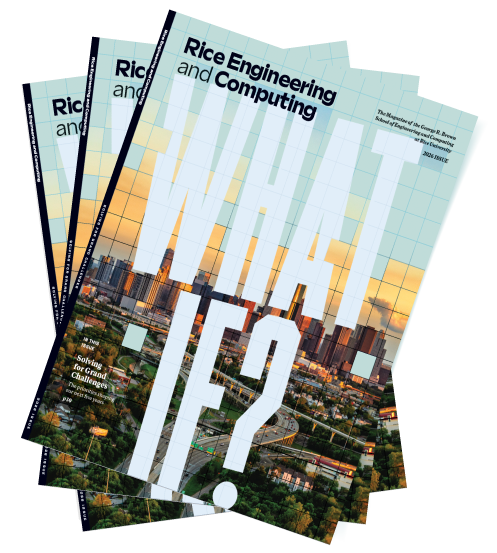
The 2026 issue of Rice Engineering and Computing Magazine is here!
This issue explores the ideas, people and partnerships shaping what comes next. Inspired by the momentum behind Vision 2030 — our school’s new strategic plan — this year’s stories highlight how our community is taking on big challenges in health and well-being, sustainability and resilience, and computing and AI. Inside, you’ll find a closer look at the research, collaborations and bold thinking driving Rice Engineering and Computing forward.

Landing the first job has become one of the biggest anxieties for new graduates. At the School of Engineering and Computing, we believe preparation begins long before graduation. Our undergraduate and graduate programs emphasize rigorous training in engineering and computing fundamentals while encouraging students to explore ideas beyond their technical disciplines. Courses across the university’s School of Humanities and School of Social Sciences help students engage with questions of ethics, policy and the societal impact of technology. The goal is not simply technical mastery but intellectual range—and the most valuable skill of all: learning how to learn. By pairing strong disciplinary foundations with an interdisciplinary perspective, we prepare students to understand the technologies shaping the world.
Understanding ideas is only the beginning; applying them is where learning takes hold. Throughout their time at Rice, students translate theory into practice through hands-on experiences that put them to work solving real engineering problems. In the Oshman Engineering Design Kitchen, multidisciplinary teams design, prototype and test new technologies. Data science students gain similar opportunities in the Data to Knowledge Lab, applying advanced analytics to complex datasets. Capstone projects, faculty research and internships further connect classroom learning with professional practice. By graduation, many students have already collaborated across disciplines and tackled meaningful technical work, building portfolios that demonstrate both creativity and capability.
Technical expertise may open doors, but collaboration, communication and leadership determine how far engineers go once they enter the workplace. At Rice, we cultivate those skills alongside technical training. Programs such as the Rice Center for Engineering Leadership and the Activate Engineering Communication Program help students develop skills in presenting ideas, managing projects and working effectively in teams. Leadership development through the Doerr Institute for New Leaders further strengthens their ability to guide teams and navigate complex professional environments. Combined with internships, research collaborations and connections to a global alumni network, these experiences ensure our graduates enter the workforce not only with a degree but with a portfolio built on knowledge, experience and the leadership, communication and collaboration skills that define modern engineering.