
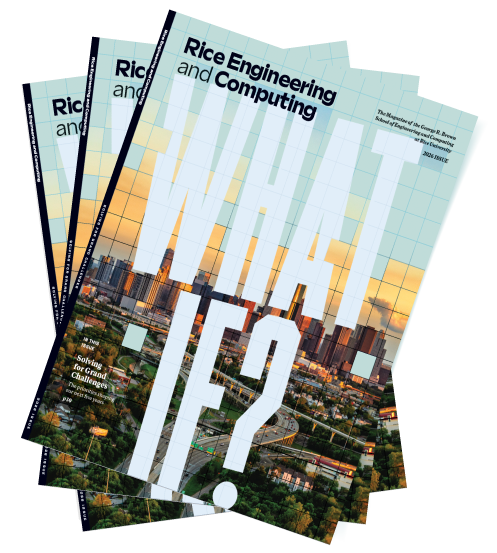
The 2026 issue of Rice Engineering and Computing Magazine is here!
This issue explores the ideas, people and partnerships shaping what comes next. Inspired by the momentum behind Vision 2030 — our school’s new strategic plan — this year’s stories highlight how our community is taking on big challenges in health and well-being, sustainability and resilience, and computing and AI. Inside, you’ll find a closer look at the research, collaborations and bold thinking driving Rice Engineering and Computing forward.
Rice Remembers
As Rice Engineering and Computing continues to advance its mission of solving for the greater good, we pause to remember the faculty and staff whose scholarship, mentorship and dedication helped define our community and inspire generations of engineers and computer scientists.
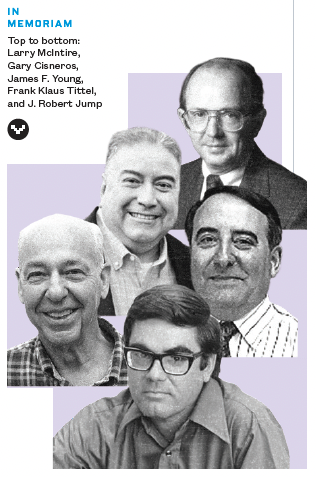
When bioengineering was still emerging, Larry McIntire helped define what it could become. He joined Rice in 1970 and later founded the Department of Bioengineering, building it into one of the nation’s leading programs. Over a lifelong career, he shaped the field as a scholar, mentor and institutional leader. His research examined how blood moves, clots and interacts with medical devices — questions central to heart disease, stroke and surgical care. That work informed safer treatments and technologies. McIntire was a member of the National Academy of Engineering.
Much of modern research depends on the precision and reliability of the tools behind it. Gary Cisneros ensured those tools worked. He joined Rice as a technician in 1996 and later served as a research specialist in the Department of Materials Science and NanoEngineering. Throughout his career, he supported a wide range of laboratory instruments used by generations of students and faculty, enabling countless experiments while guiding students in lab safety, instrument use and troubleshooting.
James F. Young, professor emeritus of electrical and computer engineering, joined Rice in 1990. He led research in photonics before turning his focus toward undergraduate teaching and mentorship, leading senior design courses and helping establish initiatives that expanded the role of engineering education in the undergraduate experience. He chaired a task force in the mid-2000s that laid the groundwork for programs focused on hands-on learning and professional development, including the founding of the Rice Center for Engineering Leadership.
Frank Klaus Tittel joined Rice in 1967 as an associate professor of electrical and computer engineering. Over a distinguished career that later earned him the title of professor emeritus, he built one of the world’s first tunable lasers capable of setting its wavelength to specific frequencies — a crucial advance for spectroscopy that helped position Rice at the forefront of optical science. Tittel’s research spanned nonlinear optics, solid-state and gas lasers and applied spectroscopy. His work in laser-based sensing of gases at minute concentrations enabled applications in environmental monitoring, chemical analysis and medical diagnosis.
J. Robert Jump, professor emeritus of electrical and computer engineering and professor of computer science, joined Rice in 1968 during a period of rapid change in computing. Over more than three decades, he educated students entering a field reshaping communication and information systems. Through his research, teaching and mentorship, he influenced generations of engineers and computer scientists at Rice and beyond.