
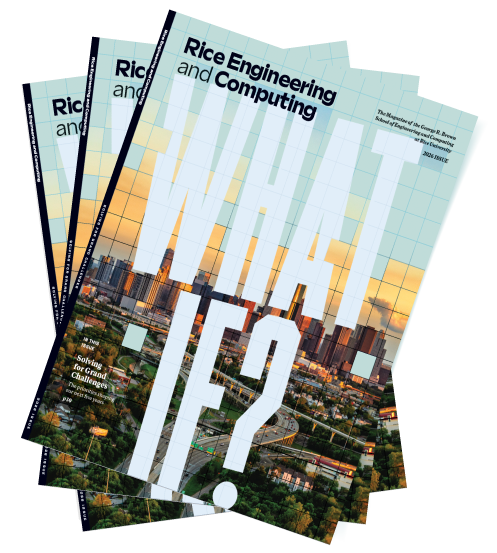
The 2026 issue of Rice Engineering and Computing Magazine is here!
This issue explores the ideas, people and partnerships shaping what comes next. Inspired by the momentum behind Vision 2030 — our school’s new strategic plan — this year’s stories highlight how our community is taking on big challenges in health and well-being, sustainability and resilience, and computing and AI. Inside, you’ll find a closer look at the research, collaborations and bold thinking driving Rice Engineering and Computing forward.
Hidden in the Data

Rice graduate Nick McMillan blends statistics, programming and storytelling to reveal patterns of harm and hold institutions accountable.
Nick McMillan ’19 made one of the biggest decisions of his life without ever visiting campus.
When his acceptance letter from Rice University arrived, he was spending a year of high school in Germany through the Congress-Bundestag Youth Exchange scholarship. He could not travel back to the United States to see the university for himself.
Instead, his mother and sister flew to Houston, toured campus and called him from the grounds. Their description stayed with him: the campus felt welcoming, collaborative and intellectually curious.
“They said everyone was incredibly warm, and that students seemed to explore a lot of different interests,” McMillan recalled.
That spirit of exploration drew him to Rice and set him on a path he hadn’t yet imagined, from engineering classrooms to investigative newsrooms.
Today, McMillan is a computational journalist at ProPublica, where he develops tools to analyze massive datasets and uncover systemic problems. His work blends statistics, programming and reporting to hold institutions accountable.
Discovering a Direction
McMillan arrived at Rice intending to become a bioengineer, drawn to the rigor and problem-solving the field required. But over time, he found himself asking different kinds of questions.
A biostatistics class sparked his interest in data analysis, and conversations with professors encouraged him to explore paths better aligned with his strengths. Shortly after, McMillan began producing videos for The Rice Thresher, the university’s student newspaper, where he was introduced to journalism.
“I wanted to develop a strong technical skill set,” he said, “but also something that could connect to storytelling.”
What began as a creative outlet became something more: a way to use technical skills to investigate, explain and communicate.
Midway through his sophomore year, McMillan switched his major to statistics. After graduating, he accepted a Scripps Howard Fellowship to practice videography and data journalism, pursued a graduate degree in journalism and became an investigative fellow at NPR, where he was later hired as a data journalist. In 2025, he and a colleague won the Ann Cottrell Free Animal Reporting Award from the National Press Club for their investigation into a federal wildlife program, as well as an Edward R. Murrow Award in Excellence in Writing for a series analyzing how the United States of America shapes its own story through historical markers.
Data as a Storytelling Medium
Many of McMillan’s investigations begin with a question about systemic harm or policy failure. The challenge is determining how to measure something not immediately visible.
“These investigative stories don’t have a clean dataset out there waiting to be analyzed,” McMillan said. “You have to figure out how to create the datasets and answer the question.”
In one project, he examined ship traffic near the habitat of the endangered Rice’s whale, formerly misclassified as a subpopulation of the Bryde’s whale, in the Gulf of Mexico. With only about 50 individuals left, the species faces risk from large vessels traveling through its habitat. At that scale, even a single loss threatens the species’ survival.
To understand how frequently ships exceeded recommended speeds, McMillan assembled and analyzed maritime tracking datasets with billions of location records—surfacing patterns that would otherwise remain hidden.
The findings helped strengthen calls for conservation measures for one of the world’s rarest whale species.
“That article was cited in a congressional letter urging NOAA to implement more protections for Rice’s whales,” McMillan said. “When people read your story and want to address the issue you uncovered, that’s incredibly rewarding.”
Although McMillan’s career now sits in journalism rather than engineering, the mindset he developed at Rice continues to shape his work. Statistical reasoning helps him determine whether patterns are meaningful, while programming skills allow him to analyze complex datasets and build investigative tools.
Looking back, he credits Rice with giving him the freedom to explore.
“I’m grateful to Rice for giving me the opportunity to explore,” he said. “It made me the type of journalist who can bring together different types of data and use them in meaningful ways. It’s not just the math or the coding: it’s using those tools to reveal problems that might otherwise go unseen.”