
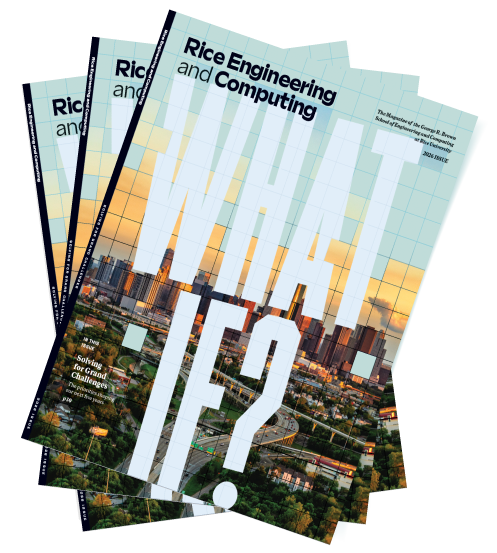
The 2026 issue of Rice Engineering and Computing Magazine is here!
This issue explores the ideas, people and partnerships shaping what comes next. Inspired by the momentum behind Vision 2030 — our school’s new strategic plan — this year’s stories highlight how our community is taking on big challenges in health and well-being, sustainability and resilience, and computing and AI. Inside, you’ll find a closer look at the research, collaborations and bold thinking driving Rice Engineering and Computing forward.
5 Questions for Dr. Alina Kampouri
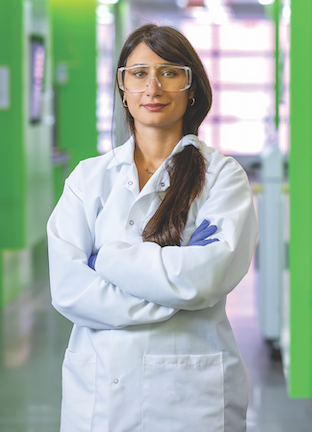
What first drew you to metal-organic frameworks (MOFs), and what continues to motivate your work today?
When I first encountered MOFs (just before starting my Ph.D.), I was not thinking about applications yet. I was simply fascinated. These were crystals so hollow that they felt almost impossible to imagine. Just one gram of the powder contains a vast network of microscopic pores–so much internal surface area that, if spread out flat, it would cover an entire soccer field. It felt like discovering a secret world inside matter. What continues to motivate me is their programmable nature. MOFs allow us to design materials almost like atomic-scale Lego sets, where structure and function can be imagined and built together. That creative freedom, turning curiosity into capability, still feels magical!
Your work sits at the intersection of chemistry and engineering. How do you approach interdisciplinary research in your lab?
Interdisciplinary thinking is not just a strategy in my lab; it is our natural language. I was trained as an engineer and later as a chemist, and I learned to value both impact and precision. My students come from chemical engineering, chemistry, applied physics, materials science, and even mathematics. What unites us is not a discipline, but curiosity and passion. Some of our most exciting ideas emerge when people with very different backgrounds talk through a problem together. We have built a culture where asking naive questions is encouraged, because that is often where creativity lives, and breakthroughs begin.
Your research includes photocatalytic systems and conductive MOFs. How could these materials help address energy or environmental challenges?
The efficiency of numerous energy and environmental technologies is often limited by the materials they rely on. My group’s research focuses on addressing that bottleneck. Using MOFs, we can design materials that combine multiple functions into a single platform. For example, a porous multi-functional material that can both capture CO2 and use sunlight to transform it into valuable chemicals, rather than relying on inefficient, multi-step processes. Conductive MOFs open similar opportunities in batteries, where controlling how electrons and ions move can improve both safety and performance. The goal is simple but ambitious: to create materials that truly work in real technologies.
Metal-organic frameworks were recently recognized with a Nobel Prize. How do you think this recognition will shape the future of the field?
The Nobel Prize feels like a celebration not just of three incredible scientists, but of an entire community and a shared way of thinking. Early on, MOFs were sometimes viewed as beautiful but fragile curiosities. Today, we know they can be robust, scalable, and ready for real-world use. I see this recognition as a turning point from discovery to deployment. It sends a powerful message, especially to students, that imaginative chemistry can grow into technologies that matter. It also celebrates a philosophy I deeply believe in, that creativity and curiosity are central to scientific progress.
What advice would you give to students or early-career researchers interested in materials chemistry or engineering?
Do not feel intimidated to cross boundaries. When you step into a new field, the initial uncertainty can actually be a strength, because it helps you question assumptions others may take for granted. That kind of curiosity often leads to breakthroughs. Over time, interdisciplinary training gives you the ability to see problems from multiple angles, which is incredibly powerful. Follow what genuinely excites you, learn from people very different from you, and remember that science is a creative process. I genuinely believe that passion, rather than the labels we attach to disciplines or titles, is what ultimately drives meaningful discovery!