
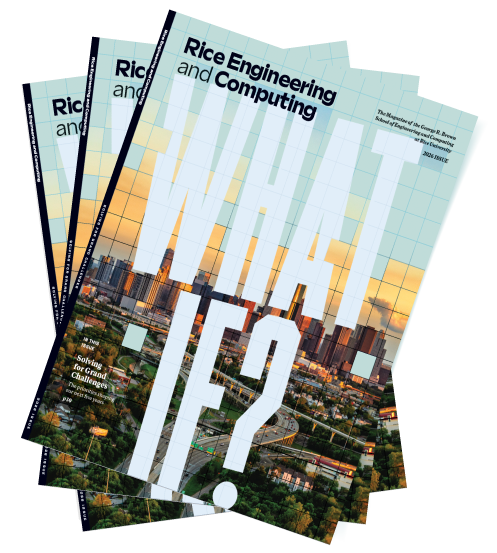
The 2026 issue of Rice Engineering and Computing Magazine is here!
This issue explores the ideas, people and partnerships shaping what comes next. Inspired by the momentum behind Vision 2030 — our school’s new strategic plan — this year’s stories highlight how our community is taking on big challenges in health and well-being, sustainability and resilience, and computing and AI. Inside, you’ll find a closer look at the research, collaborations and bold thinking driving Rice Engineering and Computing forward.
Summer Engineering Experience
Each summer, Rice engineers step beyond the classroom through the Summer Engineering Experience (SEE), a program launched by Rice Engineering Alumni to give students their first industry experience. There, they apply their skills in professional settings where problems are open-ended and the impact is real. Since its launch in 2020, the program has seen steady growth, increasing from two intern placements in 2021 to an anticipated 12 interns across nine companies in summer 2026.
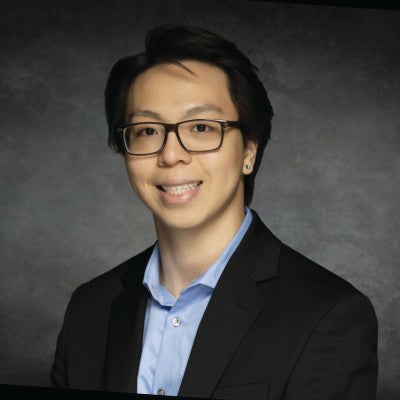
Electrical engineering student Winson Lin spent his summer at startup Prana Surgical through SEE. As a product development intern, he helped verify a flagship medical device ahead of first-in-human trials and built a temperature characterization system to support a new tumor-ablation technology.
“This internship showed me what it’s really like to work at the intersection of engineering and medicine,” Lin said. “I had to take initiative, figure things out on my own and think about how the technology we were building could eventually help patients.”
The experience strengthened his technical judgment and confirmed his interest in medtech. After graduation, he plans to pursue a Ph.D. in medical robotics.
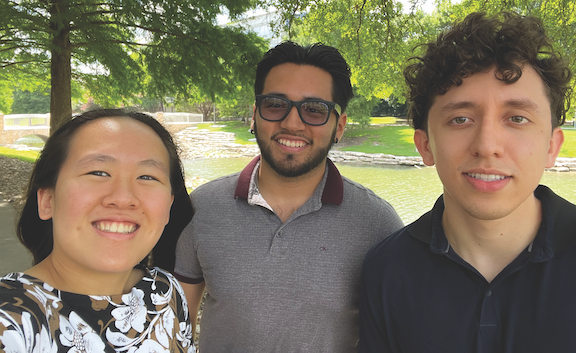
Mechanical engineering sophomore Julihannah Lu also participated in SEE, spending her summer at Blade Energy Partners, where she evaluated renewable energy systems for off-grid communities. She worked on a feasibility study combining solar power with pumped-storage hydropower, analyzing energy demand, storage capacity and cost using real-world data.
“In class, problems are clearly defined but in industry, you have to create the structure yourself,” she said. “I learned how to turn ambiguity into something you can solve.”
The experience sharpened Lu’s direction and reinforced her goal of building a career in the energy industry.
Together, their experiences reflect what SEE is designed to do: give students the opportunity to test their skills, navigate ambiguity and take meaningful steps toward the careers they’re beginning to define.