
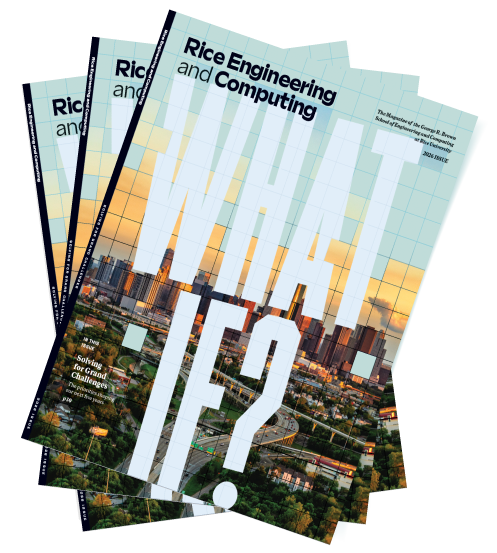
The 2026 issue of Rice Engineering and Computing Magazine is here!
This issue explores the ideas, people and partnerships shaping what comes next. Inspired by the momentum behind Vision 2030 — our school’s new strategic plan — this year’s stories highlight how our community is taking on big challenges in health and well-being, sustainability and resilience, and computing and AI. Inside, you’ll find a closer look at the research, collaborations and bold thinking driving Rice Engineering and Computing forward.
Rice in the World: Three Paths, One Mindset
Most organizations adopt new technologies by asking how to do the same things faster. Rice Engineering and Computing alumni are asking a different question: what should exist that doesn’t yet?
From Melbourne to Seoul to London, their work spans artificial intelligence, biotechnology and digital health. But the throughline isn’t the tools. It’s a habit of rethinking the systems those tools are meant to transform.

For Karin Verspoor ’93, now dean of the School of Computing Technologies at Royal Melbourne Institute of Technology (RMIT University), that shift is already reshaping both education and health care. She leads more than 100 faculty and 6,000 students while helping define what it means to prepare “AI-ready” graduates. As large language models challenge how knowledge is assessed, she argues universities must move beyond teaching content and toward something harder to measure: ethical judgment.
At the same time, through her research in digital health, she sees medicine undergoing its own transformation. Clinicians are beginning to adopt data science and AI to support a more complete picture of patient care.
“Students in all disciplines need to learn to work with these tools,” Verspoor says, “and leave university clearly able to add their human value to these powerful machines.”
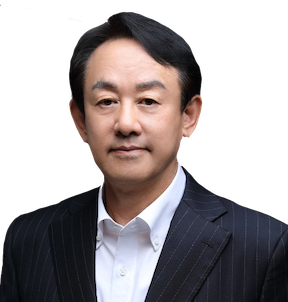
That same instinct — to work at intersections rather than within silos — has defined the career of B.G. Rhee ’85 in biotechnology. Now a special advisor to Flagship Pioneering, he is helping connect South Korea’s rapidly advancing biotech sector with global innovation networks at a moment when the industry itself is being reshaped.
“Science thrives at intersections,” Rhee says, reflecting on a formative Rice experience working across engineering and biology. “The most transformative ideas come from combining perspectives.”
Today, that principle guides his work building what he describes as “a two-way flow of science, entrepreneurship and investment” across continents — linking researchers, clinicians and companies to accelerate drug development and expand the reach of new therapies.
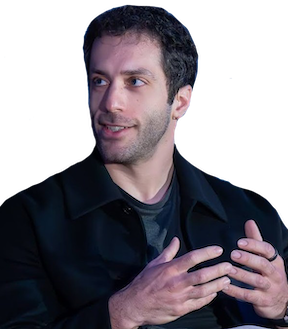
At Google DeepMind in London, Kareem Ayoub ’12 applies that mindset on a global scale. As vice president of AI technical strategy, he works across research, product and deployment to translate breakthroughs into systems that create entirely new forms of value.
“The biggest shift we’re experiencing now is the transition from AI models as the product to AI agents,” he says. “Agents can pursue goals and make decisions. But the real challenge is not technical.”
“Most organizations approach AI by automating what already exists. That’s the faster horse trap.”
He points to the evolution from AlphaGo to AlphaFold: the same underlying advances in machine learning applied in ways that helped evolve how a 3,000-year-old game is played, accelerate protein-folding research by 214 million years and enable the study of black hole collisions.
“The translation isn’t technical,” Ayoub says. “It’s imaginative. What becomes possible that wasn’t before?”
Across their work, these alumni share a distinctly Rice approach: not just solving problems, but redefining them. Whether redesigning how students learn, connecting biotech ecosystems across continents or pushing artificial intelligence beyond automation, they show that the real impact of technology doesn’t come from what it replaces but from what it makes possible.