
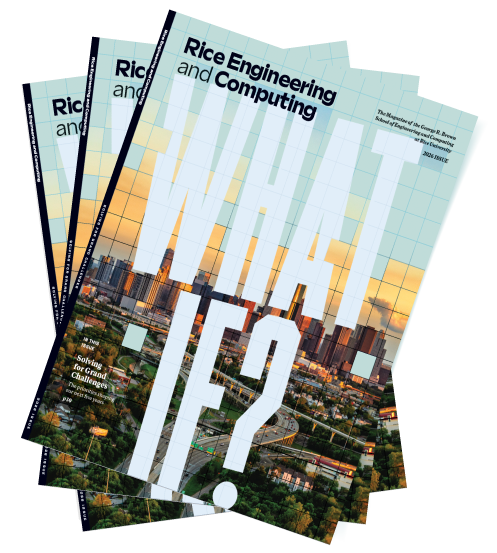
The 2026 issue of Rice Engineering and Computing Magazine is here!
This issue explores the ideas, people and partnerships shaping what comes next. Inspired by the momentum behind Vision 2030 — our school’s new strategic plan — this year’s stories highlight how our community is taking on big challenges in health and well-being, sustainability and resilience, and computing and AI. Inside, you’ll find a closer look at the research, collaborations and bold thinking driving Rice Engineering and Computing forward.
Solving for Grand Challenges
What if where you live no longer determines the care you receive? What if water systems could adapt as quickly as the pressures on them? What if artificial intelligence doesn’t just deliver answers but helps us understand?
At Rice University’s School of Engineering and Computing, questions like these are shaping the next five years of research. Faculty have identified nine grand challenges—problems too urgent, too complex, and too consequential to ignore. Together, they define where the school is headed and what it will take to get there.
Here, we focus on three. Each is already underway, driven by teams working to redesign how care is delivered, how water is treated, and how learning evolves in the age of AI.
The questions are ambitious. The timelines are short. And the answers are closer than we think.
The Care Gap
Whether it’s a clinic in sub-Saharan Africa or an emergency room in rural Texas, engineers at Rice University are working on the same problem: how to deliver quality care and provide access to people the healthcare system struggles to reach.
Somewhere right now in Texas, a mother is driving two hours to the nearest clinic, her sick child asleep in the back seat. A retiree is cutting his pills in half, stretching a month’s prescription into two. A rural community is making do without the specialist it needs. Different lives and different zip codes but the same gap in care.
Researchers at Rice University believe there is a better way. At the Rice360 Institute for Global Health Technologies (Rice360), the work starts with a deceptively simple idea: where you live and who you are shouldn’t determine the care you receive. The goal is to make quality healthcare something every community can count on, no matter the distance, the cost, or the circumstances.

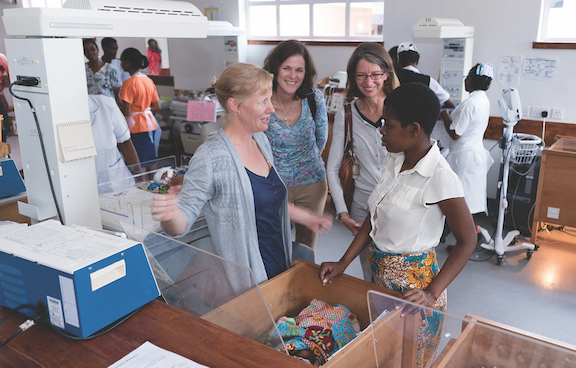
Rice360 was founded in 2009 by Rebecca Richards-Kortum and Maria Oden, both bioengineering professors at Rice, with a two-part mission: build affordable healthcare devices for underserved communities and train the next generation of problem-solvers to put them to work.
“We work with partners to understand the gaps they face in delivering care,” Richards-Kortum says, “and then turn that into an opportunity to invent or translate new technologies.”
That approach has produced a portfolio of devices designed not to rethink what’s possible, but to achieve the same standards of care in hospitals with limited resources. Rice360, together with the NEST360 program, has identified 41 affordable, durable, quality technologies to address preventable newborn deaths. And where no suitable solution existed, the institute built one. Among the Rice360 devices developed for newborn care is the Pumani, a low-cost bubble CPAP that helps premature and struggling newborns breathe, as well as the BiliDx, a bilirubinometer that measures bilirubin at the bedside to allow for quick jaundice treatment during the critical minutes after birth.
In the Pumani, air mixed with oxygen flows to the infant through nasal prongs, while exhaled air is directed into a tube placed under water. As that air escapes, it forms bubbles; the deeper the tube sits, the more resistance the air must overcome to get out, which creates steady pressure in the airway. Adjusting the water depth changes the pressure—no electronics required. The pressure from Pumani keeps the infant's lungs partially inflated, making breathing easier.
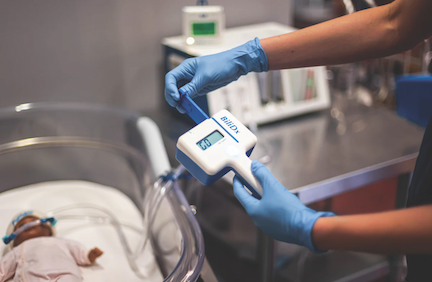
The BiliDx starts with a drop of blood placed on a disposable strip. As the sample moves along the strip, the red blood cells separate from the plasma, allowing the clear plasma to continue forward toward the test window. The reader then shines light through the plasma and measures the intensity of the transmitted light to calculate bilirubin levels. The whole testing process happens within the handheld reader, simplifying a process that would normally require a lab and a centrifuge.
Both technologies are engineered from the ground up for environments where electricity is unreliable, supply chains are thin, and a biomedical technician may be the one keeping the equipment running. Many solutions began as undergraduate student projects, a reflection of Rice360’s conviction that training innovators and building innovations are inseparable goals. That pipeline runs deep: Rice360 offers undergraduate minors and a newly launched graduate certificate in global health technologies, all built around hands-on work in under-resourced settings.
That approach finds one of its most powerful expressions in NEST360, Newborn Essential Solutions and Technologies, a program with an international alliance co-led by Rice360 that is working to end preventable newborn deaths in sub-Saharan African hospitals in partnership with governments. Operating together with 23 partner institutions in five African countries, the program delivers a comprehensive system of affordable, durable, quality newborn technologies, paired with hands-on training and education, and data-driven quality improvements.
“The program is successful with an approach that delivers a package of technologies,” Richards-Kortum says, “trains nurses, doctors, and biomedical engineers how to care for the smallest and sickest babies and maintain the equipment—and by implementing dashboards that track coverage and quality of care, then intervening to improve quality where it's lacking.” The results speak for themselves. Roughly 100,000 babies receive care each year in NEST360-affiliated hospitals and in Malawi, where NEST360 is present in every hospital, newborn mortality in hospitals has dropped by 23%.
Now, Rice360 is turning its sights closer to home. “We’re at the beginning of a really exciting opportunity to take the lessons learned from NEST360 in Africa and apply them to improving the health of women and babies in the state of Texas,” Richards-Kortum says.
The need is real. Nearly half of Texas counties are considered maternal health deserts, places with no hospital offering labor and delivery services, where a pregnant woman must travel hours elsewhere to give birth, often facing significant barriers along the way. Texas ranks 45th nationally in healthcare outcomes, and more maternal deaths occur here than in any other state. Affordable technology, digital health tools, home-based monitoring and telehealth all play a role in bridging that gap. Rice's recently established Digital Health Institute, a joint venture with Houston Methodist, is already building the translational infrastructure to move innovations from lab to clinic to community.
The stakes become concrete quickly. A colleague of Richards-Kortum visited a county that recently became a maternal health desert due to the closing of the nearest delivery hospital. The visit found that women on the verge of delivery are now sent to a nearby emergency room whose staff haven’t routinely delivered babies in decades and therefore lack basic equipment, something as simple as a warming cot for a premature newborn.
“Thinking about what the technology needs are in a setting like that is really important work,” Richards-Kortum says, “and it's a place where research happening at Rice can make a real difference.”
In Texas, that work might mean making sure a newborn stays warm in the first minutes of life. In hospitals across sub-Saharan Africa, it has already meant thousands of babies getting quality care from day one of life; a chance they might not have had otherwise. The settings are different, but the approach is the same: start with the gaps and build what’s needed to close them.
Running Dry
Water systems weren’t designed for the pressures they now face. Rice University is building the case and the technology for something fundamentally better.
Of all the resources the world depends on, none is under greater stress than water. In Houston, the pressures are unusually acute: a sprawling coastal city contending simultaneously with flooding, land subsidence, saltwater intrusion and the water demands of one of the world’s largest industrial economies. What happens here, in many ways, is a preview of what happens everywhere.
“Clean water can save more lives than doctors,” Pedro Alvarez, director of the Rice WaTER Institute and recipient of the 2026 Benjamin Franklin Medal in Civil Engineering, has said. It’s a provocative line, but the data backs it up. And it captures exactly the kind of thinking that animates the institute he leads.
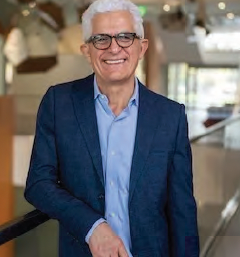
“It’s more of an innovation ecosystem,” says Menachem Elimelech, the institute’s lead researcher on water and energy and one of the world’s foremost authorities on water quality engineering and membrane technologies. “The core focus, at least on the technical side, is really about moving away from large, chemical-intensive water treatment plants toward more compact, modular and energy-efficient systems that can provide fit-on-demand treatment. The idea is to tailor the technology to the specific problem and design accordingly, rather than relying on large, centralized plants that aren't flexible.”
That vision didn’t emerge out of nowhere. The Rice WaTER Institute, launched in January 2024, grew directly out of the university's Nanotechnology Enabled Water Treatment Center known as NEWT, a $37 million, decade-long initiative funded by the National Science Foundation. Over ten years, NEWT produced more than 900 research publications, 45 patent disclosures and trained roughly 200 graduate students across 30 faculty labs at four universities.
NEWT didn’t end. It evolved. Its mission now continues through the NEWT Alliance, a multi-institution network with Rice at its center. The Rice WaTER Institute is both a continuation and an acceleration of the research and alliances that were built by NEWT. Its work is organized around three pillars, each targeting a different dimension of the global water crisis.
The first is water and public health, the threat posed by contaminants like PFAS, the “forever chemicals” that have become a defining environmental challenge of the past decade. But the institute’s public health mission goes beyond identifying threats. It is pushing toward a fundamental change in how water gets treated in the first place.
Much of today’s infrastructure, Elimelech points out, relies on approaches that haven't meaningfully changed in a century. “It's technology that has not changed in the last hundred years,” he says. “All these chemicals make it complicated. You get a lot of sludge. You need trucks to bring the chemicals.” The trajectory, he says, is toward less chemical-intensive, more energy-efficient approaches such as membranes, electrochemical processes and compact modular systems that can be tailored to specific needs.
The second pillar, and Elimelech's primary area of research, is the water-energy nexus. Producing water requires energy. Producing energy requires water. And as both resources come under increasing strain, the inefficiencies of the current paradigm become harder to ignore.
At the heart of Elimelech's work is the challenge of augmenting water supply through desalination and wastewater reuse and doing so in ways that are greener, more circular and less energy-intensive than existing approaches. Desalination inevitably produces brine, a highly concentrated byproduct that can't simply be discarded.
“We need to find some way to continue to squeeze all the water out,” he says, “so you're left with nothing. Just very, very concentrated, almost solid material.” Increasingly, that brine is being reconceived not as waste but as a resource. Magnesium and lithium can be recovered from these concentrates, while sodium chloride can be converted to produce acids and bases.
The lithium angle is particularly striking. In Texas oil and gas fields, vast quantities of brine come up alongside every barrel of crude. Elimelech’s group has found that these brines contain lithium in concentrations high enough to make recovery economically viable. The challenge is selectivity: separating lithium from chemically similar elements like sodium requires membranes of extraordinary precision. His reference point, characteristically, is biological. The potassium channel, a membrane structure in human cells, admits potassium while blocking the nearly identical sodium ion. “We are not as smart as nature,” Elimelech says, “but we are trying to mimic it.”
That same precision carries into the institute’s third pillar: resilient infrastructure. The vision is a departure from the centralized, aging systems most cities rely on—modular, autonomous treatment units capable of handling everything from brackish groundwater to high-salinity industrial wastewater. These systems are digitally integrated through sensors, AI-driven monitoring and digital twins. Houston, with its unique combination of industrial scale, climate vulnerability and civic complexity, is the living laboratory where these ideas get tested.
What distinguishes the WaTER Institute is not any single technology but rather the environment in which the work happens. Its collaborative structure and culture function as a competitive advantage. The institute draws on an unusually broad disciplinary base: materials science, data science, environmental policy and social science. That breadth is paired with a deliberate commitment to moving research into practice through industrial partnerships, federal funding and the startups that have already emerged from its predecessor.
Houston is not merely the setting for this work. It is the proof of concept, a test case for a model the institute believes can scale to other coastal cities, industrial centers and regions where the gap between the water available and the water needed keeps growing.
It’s necessary work, but Elimelech is clear-eyed about the pace of change. Water is not software, and new approaches can take years, sometimes decades, to reach widespread use. Even the most promising startups often need the better part of a decade before they have a market-ready product. In water, breakthroughs don’t announce themselves. They accumulate. For Elimelech, that's not a source of frustration. It’s simply the nature of the work. “You need to be patient,” he says. And in a field where the stakes are this high, patience isn’t a virtue so much as a requirement.
The Struggle is the Point
Students have more information available than at any point in history. According to the Lumina Foundation-Gallup 2026 State of Higher Education study, 57% of U.S. college students now use AI in their coursework weekly, with many using it daily. Yet, attention spans are shrinking and shortcut content is everywhere. Richard G. Baraniuk, the C. Sidney Burrus Professor of Electrical and Computer Engineering at Rice University, sees what researchers have called an "attention crisis," now accelerating as AI tools make it easier to bypass deeper thinking.
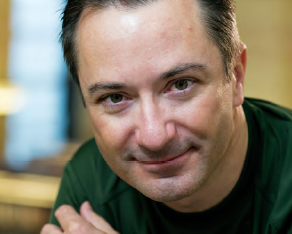
Baraniuk has spent two decades building infrastructure to address problems like this one. He founded OpenStax, one of the largest open educational resource providers in the world, with more than 80 free, peer-reviewed digital textbooks and supporting technology reaching millions of students in high school, college, and across 169 countries. He also founded SafeInsights, a national infrastructure for education research. Together, they form a trusted knowledge base and a research engine, and they're now foundational to a more ambitious effort: AI for education that's grounded in how people actually learn.
Rice University’s growing AI for education initiative includes OpenStax, SafeInsights, Rice Digital Learning, and various faculty and leaders from the School of Engineering and Computing, the School of Social Sciences, the Glasscock School of Continuing Studies, and Rice operations. The challenge is to build AI tools that are truly “responsible” for teaching and learning, meaning they are fair, safe, grounded in learning science, continuously evaluated, and designed for real classrooms.
Baraniuk believes that well-designed AI can help address the attention crisis. A single instructor can't personalize learning for 200 students in a lecture hall, and content goes stale faster than author teams can rewrite it. AI can adapt in real time, adjusting its teaching based on what a student knows, where they're stuck, and how they learn best, while keeping the instructor at the center of the experience. "We can bring proven principles of learning science into everyday teaching at scale," Baraniuk says. "Things that great tutors have always done, meeting a student where they are, calibrating the challenge, knowing when to push, can now reach millions of learners."
The trouble is that AI designed without learning science makes the problem worse. The OECD's 2026 Digital Education Outlook found that students who use AI produce higher-quality work but learn less, a paradox that disappears only when the tools are built with an understanding of how people actually acquire knowledge.
So the foundational question becomes: what works, for whom, and in what context? Most AI tools today can't answer it because they have no model of the learner. They generate fluent text without knowing whether the student on the other end is working through a new idea or stuck on a misconception they've held for years. Baraniuk’s team of researchers and engineering students is exploring ways for AI to track the learning context: the who, what, when, where, and with whom of a student's experience. With that kind of understanding, AI can appropriately scaffold in real time and keep a student working at the edge of what they know, thereby stretching the limits of what they could learn on their own.
You can't study the learning context with classroom observations. That kind of research requires infrastructure that didn't exist until recently. SafeInsights, backed by a $90 million National Science Foundation (NSF) investment, is building the first national research infrastructure for education research. The design connects digital learning platforms, including OpenStax, with a community of researchers to study how students learn within them, and across them, without moving student data. This architecture enables researchers to send analyses to the platforms, which run them in secure enclaves to return aggregated results. No identifiable student data ever leaves. Think of it like a large-scale telescope that enables rigorous questions across millions of learners rather than a single classroom.
As more instructional ideas become possible to examine, Rice can be a place to build and test tools alongside students and instructors. Last fall, this work extended into Rice's peer tutoring center at the encouragement of Dean Luay Nakhleh. "Tutoring centers are fascinating," Baraniuk says, "because students show up when they're genuinely stuck. They want to leave actually understanding something."
Baraniuk, alongside Assistant Teaching Professor Lorenzo Luzi and scientific director Dr. Debshila Basu Mallick, taught a new project-based course, ELEC 631: Human/AI Teaming in Education, that embedded Rice students in Rice's Office of Academic Support for Undergraduate Students. The goal was to listen to peer tutors to understand the problems they face and design and prototype end-to-end AI-supported solutions. One team learned that tutors had to start every session from scratch and built a multi-agent AI application that tracks each student's learning context. The teams iteratively refined their prototypes over the course of the term, and some continued to pursue them even after the course ended. For solutions that have been shown to work, OpenStax can extend them to students worldwide.
But building better tools raises a harder question: how do you know the learning actually sticks? Traditional assessments are losing their grip on what students actually know. When AI can generate a passing answer, the exam measures access to tools, not understanding. A recent tool developed by the team and set for study this coming school year takes a different approach. Instructors design the structure, anchoring conversations in specific course material and defining the learning progression, and then AI-guided dialogues walk students through problems, asking them to reason, clarify, and defend their thinking. The point is to surface understanding through conversation.
"If you got it right immediately, you already knew it," Baraniuk says. "You don't learn without a struggle." But not just any struggle. Learning science shows that a task has to be hard enough to demand real effort but close enough to be solvable with support — and a student has to persist with it long enough for understanding to take hold.
Critical thinking is the capacity that productive struggle builds, and Baraniuk argues it's the real value of a college education going forward. The goal of AI for education isn't to make learning easier. It's to stretch the limits of what every student can reach.