
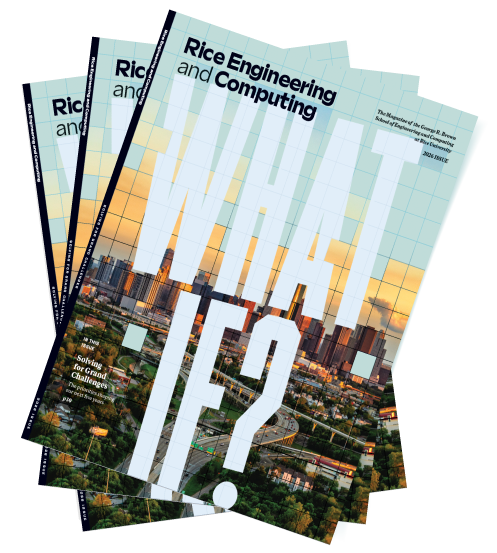
The 2026 issue of Rice Engineering and Computing Magazine is here!
This issue explores the ideas, people and partnerships shaping what comes next. Inspired by the momentum behind Vision 2030 — our school’s new strategic plan — this year’s stories highlight how our community is taking on big challenges in health and well-being, sustainability and resilience, and computing and AI. Inside, you’ll find a closer look at the research, collaborations and bold thinking driving Rice Engineering and Computing forward.
Before a patient takes a step, a storm makes landfall or a genetic design enters a cell, Rice engineers are changing what’s possible. We’re rethinking how we predict, prepare and design—shaping decisions in patient care, urban resilience and genetic engineering.
AI Meets Biology: Engineering the Future of Genetic Design
For decades, synthetic biology has pursued a bold goal: to program living cells with the same predictability as computers. The field has delivered remarkable breakthroughs, from microbes engineered to produce life-saving drugs to immune cells equipped with synthetic genetic circuits that enhance their ability to fight tumors.
However, biological systems are extraordinarily complex. Genetic designs that look promising in theory often fail in living cells. Hidden interactions between genes, proteins and environmental factors can produce unexpected results, forcing scientists into lengthy cycles of trial, error and redesign. By integrating machine learning with synthetic biology, Rice researchers make genetic engineering faster, more reliable and more scalable.
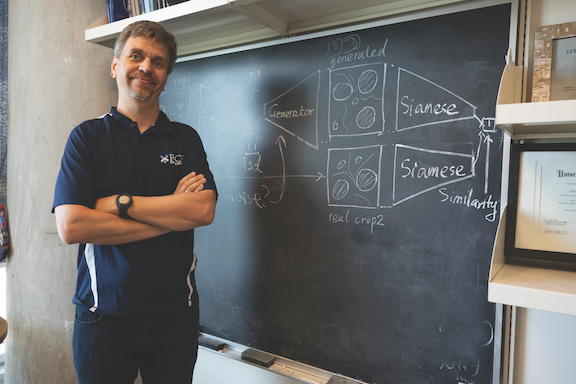
“Despite decades of biophysics, we’re still not very good at predicting how biological parts will behave in new contexts,” says Oleg Igoshin, professor and associate chair of bioengineering at Rice University. “In trial-and-error mode, we build something, it does or doesn’t work, then we troubleshoot and try again. With artificial intelligence, you can learn much faster and on a much bigger scale, gaining insight from every failure and success along the way to improve results.”
Today, synthetic biology laboratories can generate and characterize enormous libraries of DNA design variants through high-throughput experiments. These datasets provide the raw material for training machine learning models that detect subtle relationships between genetic sequences and biological function.
In a recent Nature study, Rice researchers led by Caleb Bashor, assistant professor and deputy director of the Rice Synthetic Biology Institute, demonstrated the first successful use of AI to design genetic circuits in human cells. Their platform, called “CLASSIC,” pairs high-throughput experimentation with machine learning to generate and test vast libraries of DNA designs, revealing how genetic sequences translate into cellular behavior.
The long-term vision is a predictive framework for genetic design. Instead of relying on repeated trial and error, researchers could use AI to predict which DNA programs are most likely to succeed and even generate entirely new designs optimized for specific tasks.
"AI has already transformed our ability to predict protein structures," Igoshin says. "Now, we are seeing rapid progress on the inverse challenge: using AI to design brand new proteins from scratch. But we need to go further: using AI to architect the complex circuits of interacting genes and proteins that unlock entirely new capabilities at the cellular level and beyond."
The implications span medicine, sustainability and biotechnology. In medicine, AI-guided genetic design could enable more precise cellular therapies, advanced diagnostics or new drugs. Engineered microbes could help produce renewable chemicals, capture carbon or break down environmental pollutants. Across industries, predictive design could shorten development timelines and lower the cost of bringing new technologies to market.
Rice’s interdisciplinary strengths position it to lead this emerging field, bringing together expertise in synthetic biology, data science, machine learning and computational modeling.
“At Rice, we are at the forefront of both AI-based research and synthetic biology,” says Igoshin. “By bridging these fields, we’re accelerating discovery and advancing what’s possible.”
Designing Smarter, More Resilient Cities—Before Disaster Strikes
From 1980 to 2024, Texas experienced 190 climate and weather-related disasters that each caused more than $1 billion in damage, 68 of them in the last five years, according to the National Oceanic and Atmospheric Administration. As severe weather events grow more frequent and complex, cities can no longer rely on reacting after disaster strikes.
At Rice University, engineers are designing “smart resilience” tools and systems that help communities anticipate failures, identify vulnerabilities and make better decisions before a storm ever arrives. By combining advanced modeling, new data sources and close partnerships with government agencies, their works aim to help cities better understand risk and prepare for what’s ahead.
Rice is also home to initiatives such as the Severe Storm Prediction, Education and Evacuation from Disasters (SPEED) Center and the Ken Kennedy Institute’s AI for Climate Risk and Resilience cluster, which expand the university’s efforts to understand and address climate-related threats.
“Cities like Houston face incredibly complex challenges,” says Jamie Padgett, the Stanley C. Moore Professor and chair of the civil and environmental engineering department. “The natural environment, the built environment and human systems all interact during extreme events. To understand and reduce risk, we are bringing together expertise from across disciplines.”
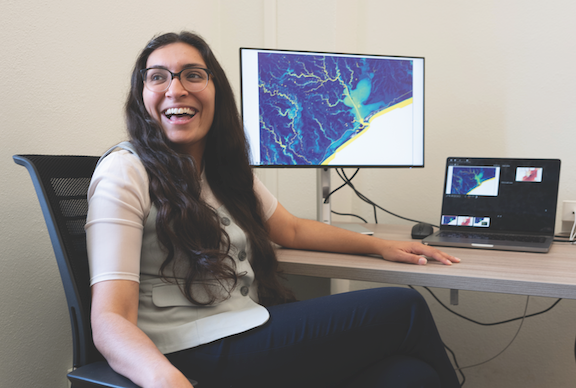
In a NASA-funded collaboration, Rice researchers are supporting regional risk mitigation planning across the Houston-Galveston area. The team, led by Avantika Gori, assistant professor of civil and environmental engineering, is exploring how high-resolution satellite data—such as soil moisture conditions before a storm—can improve probabilistic hurricane models to better forecast flooding, storm surge, debris and infrastructure damage.
Working with partners such as the Houston-Galveston Area Council, Rice researchers hope to translate these insights into action. More precise forecasts could help local government planners pinpoint the most vulnerable locations and direct mitigation projects where they will have the greatest impact.
Another collaboration, the Consortium for Enhancing Resilience and Catastrophe Modeling (CERCat), brings together academia and industry partnerships from insurance and reinsurance to engineering consulting to ensure new models address real-world needs.
Another effort, supported by the National Science Foundation, focuses on improving situational awareness during storm events through an AI-enabled platform called OpenSafe.AI. Emergency responders often rely on fragmented, sometimes conflicting information from weather forecasts and traffic cameras to reports from people on the ground. Rice researchers are developing tools that integrate these data streams into a single, more reliable picture in real time.
By coupling the best science with emerging data sources such as social media reports, traffic cameras and field observations, the system aims to provide emergency managers with clearer predictions about flooding, road access and storm progression.
“Responders often have to make critical decisions very quickly,” Padgett says. “Our goal is to provide a trusted platform that integrates the best available data and modeling so they can understand what’s happening across the city and plan safe routes to hospitals, fire stations or affected neighborhoods.”
Together, these efforts reflect a larger shift at Rice, taking disaster resilience from a single line of research to a growing, campus-wide priority.
“Rice has built a unique community and strong foundation in this space. And it continues to grow,” Padgett says. “We’re combining deep expertise with emerging technologies and working closely with communities and industry to make sure this research leads to real impact for communities around the world.”
Personalized Digital Models to Help Patients Move—and Recover—Better
Every person is unique. But for treating movement impairments caused by musculoskeletal or neurological conditions, generic interventions are still the norm, with patients often recovering less function than desired. At Rice Engineering and Computing, researchers are seeking to improve patient outcomes using a unique approach to personalized medicine.
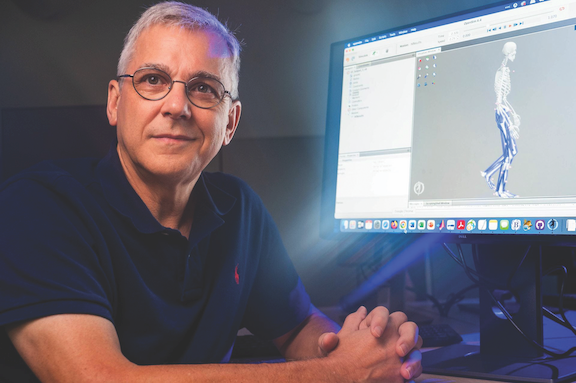
Led by B.J. Fregly, Trustee Professor of Mechanical Engineering and Bioengineering and a Cancer Prevention and Research Institute of Texas (CPRIT) Scholar, the team is developing personalized computer models of individual patients called “digital twins.” By performing virtual treatments on a patient’s digital twin, researchers collaborating with clinicians can simulate different surgical, rehabilitation or neurorehabilitation strategies and predict the patient’s post-treatment movement function. Comparing these predictions with actual post-treatment outcomes allows the team to continually refine its computational treatment design process.
“Ultimately, we want to model real people so that we can design real treatments,” Fregly says. “The first treatment I designed was for my own knees.”
The team’s software, the Neuromusculoskeletal Modeling (NMSM) Pipeline, builds on the widely used OpenSim platform. It creates a digital twin using pre-treatment data collected in a motion lab, where the patient performs movements while motion capture cameras track body markers, force plates measure ground contact forces, and sensors record muscle electrical activity. These data enable the NMSM Pipeline to reconstruct each patient’s functional anatomy and physiology—how joints move, how muscles function and how the brain coordinates motion. Because the digital twin is grounded in physics and physiology, it can predict the patient’s movement function in post-treatment scenarios where no data are available. Fregly’s team has already produced the only validated computational prediction of a real person walking in 3D under new conditions.
The team is collaborating closely with local clinicians to apply this technology. With MD Anderson Cancer Center, they are simulating how pelvic cancer surgeries affect walking outcomes. At TIRR Memorial Hermann Hospital, they are designing personalized muscle stimulation prescriptions to restore walking after stroke. At UT Health, they are predicting how surgical decisions for knee osteoarthritis influence joint loading. Additional clinical applications include cerebral palsy and spinal cord injury.
Fregly envisions a future in which digital twins are routinely created before treatment to compare options and guide care. “If we can predict how a patient will move after treatment,” he says, “then we can offer options that will help the patient choose the path to the best quality of life.”