
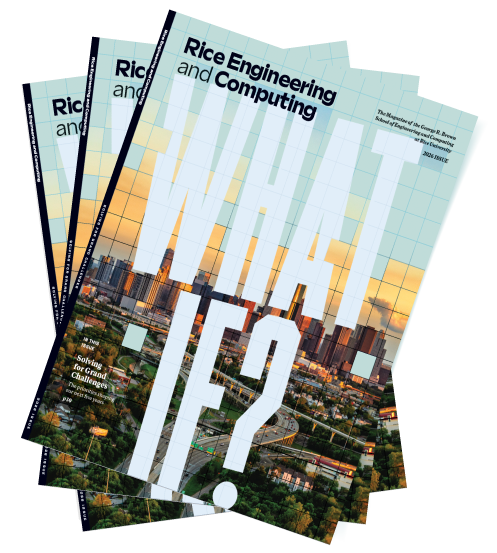
The 2026 issue of Rice Engineering and Computing Magazine is here!
This issue explores the ideas, people and partnerships shaping what comes next. Inspired by the momentum behind Vision 2030 — our school’s new strategic plan — this year’s stories highlight how our community is taking on big challenges in health and well-being, sustainability and resilience, and computing and AI. Inside, you’ll find a closer look at the research, collaborations and bold thinking driving Rice Engineering and Computing forward.
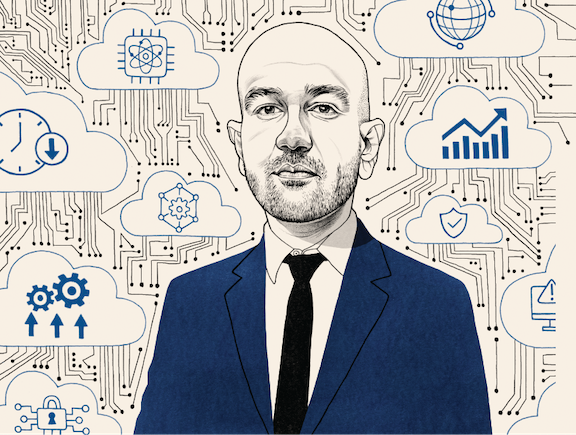
In Their Own Words: When the Cloud Goes Quantum
By Tirthak Patel, Assistant Professor of Computer Science
Most of us take cloud computing for granted. We write code, click “run,” and trust that somewhere machines will execute our programs correctly, securely and efficiently. But as quantum computers begin to move into shared cloud platforms, that trust can no longer be assumed. Quantum hardware behaves fundamentally differently from classical (everything that’s not quantum) machines, and the cloud abstractions we rely on today simply do not translate.
At the Positive Technology Lab, our research is about preparing cloud computing for a quantum future. We ask a simple yet consequential question: If quantum computers are accessed through the cloud to run scientific and AI programs, how do we ensure they are usable, reliable and safe?
Our work spans three connected components of the quantum cloud stack.
The first component is compilation, learning and systems-level management. Quantum programs cannot be compiled once and run “everywhere.” Different quantum technologies, such as superconducting transmons, trapped ions or neutral atoms, each come with their own constraints and specifications. Even basic operations, such as measuring a qubit (quantum bit), introduce challenges that have no classical equivalent. Our group designs compilation and error-correction techniques that translate high-level quantum programs into hardware-aware executions, accounting for routing, timing and the fragility of quantum states. The goal is to make quantum hardware usable without forcing programmers to reason about every physical qubit and control pulse.
The second component is resource management in the quantum cloud. Unlike classical systems, quantum computers exhibit extreme variability. Two identical jobs may experience very different service times, measurement fidelity or output accuracy depending on when and where they run. This variability makes performance unpredictable and undermines scientific reproducibility. Our research focuses on scheduling, queuing and dispatching strategies that reduce this uncertainty. By designing cloud systems that account for noise and uncertainty, we aim to reduce surprises for users.
The third component is security and privacy. Cloud users today assume that their code and data are protected, but quantum computing complicates this picture. Quantum programs are reversible, their outputs are probabilistic and their structure can leak sensitive information. A curious cloud provider or a malicious observer could potentially infer details about an algorithm, a dataset or even a user’s intent. Our group studies these emerging vulnerabilities and develops defenses that hide quantum programs, protect inputs/outputs and limit what third parties can learn, without sacrificing performance.
Across all of this work, we design with change in mind. Quantum hardware is improving rapidly. Today’s machines are noisy and limited. Tomorrow’s machines will be larger, more reliable and eventually fault-tolerant. Systems built only for current devices will not last. Our solutions are designed to adapt as technology evolves so that ideas developed for today’s machines still matter when quantum computers become more dependable.
Quantum computers are often described as futuristic or mysterious, but in reality they are becoming something much more practical: shared, remote resources. They will be cloud machines that many people rely on without ever seeing. Our work is about ensuring that when that moment arrives, the quantum cloud is not just powerful, but efficient, reliable and trustworthy.