
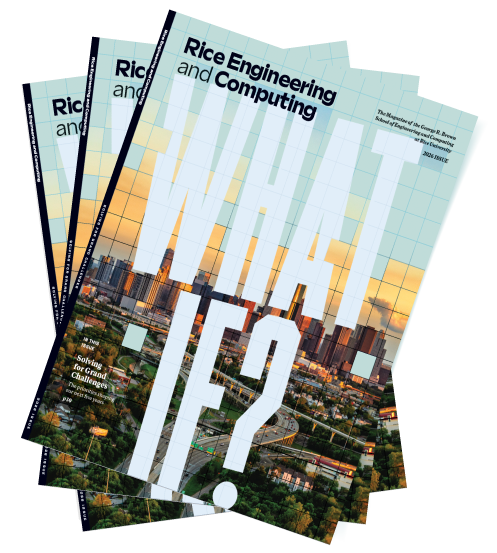
The 2026 issue of Rice Engineering and Computing Magazine is here!
This issue explores the ideas, people and partnerships shaping what comes next. Inspired by the momentum behind Vision 2030 — our school’s new strategic plan — this year’s stories highlight how our community is taking on big challenges in health and well-being, sustainability and resilience, and computing and AI. Inside, you’ll find a closer look at the research, collaborations and bold thinking driving Rice Engineering and Computing forward.
Rice alumna played key role in NASA's Artemis II lunar mission
As NASA’s Artemis II marked a historic return to crewed lunar flight, a Rice University alumna is helped monitor the spacecraft in real time from the ground.
Quyen Tran Jones, who earned her bachelor’s degree in mechanical engineering from Rice in 1993, was part of the team working inside NASA’s mission control complex built to host the Orion Mission Evaluation Room. This critical hub at Johnson Space Center in Houston supported the agency’s first crewed lunar mission in more than 50 years.
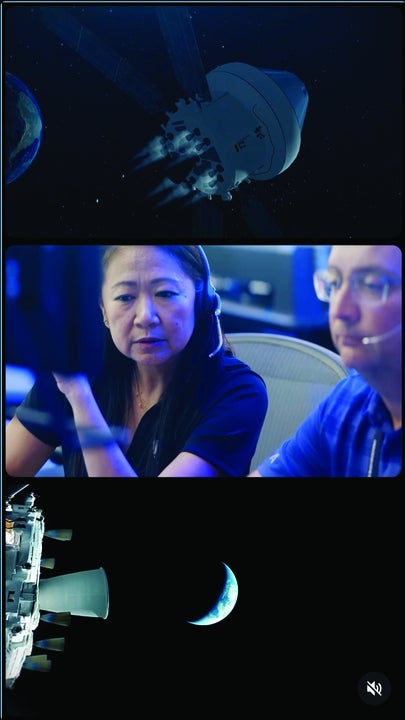
From her console, Jones helped track the forces acting on the Orion spacecraft during flight — everything from air pressure to rocket thrust — ensuring the vehicle performed as expected in the harsh environment of space.
“We saw a really good launch. Everything went according to plan,” Jones said in a NASA interview posted on Johnson Space Center’s Instagram account. “We have to check the solar arrays — that when they deploy, they don’t go under any unexpected loading — and they didn’t. They deployed beautifully.”
Her team also monitored the spacecraft’s configuration and orientation as it executed key maneuvers.
Inside the Mission Evaluation Room, dozens of engineers analyzed real-time data from Orion, working in close coordination with flight controllers in mission control’s White Flight Control Room, who operated and sent commands to the spacecraft. The evaluation room provided critical engineering insight, helping assess performance and respond quickly to any unexpected behavior.
Jones’ work focused on mechanisms’ thermal protection systems and loads and dynamics — disciplines essential to ensuring the spacecraft could withstand the intense forces encountered during launch, deep space travel and reentry.
“Once we get the in-flight data and can compare and confirm what some of our assumptions were that were based on testing and textbooks, and confirm that in space, I’m excited for that,” she said. “And I’m excited to see humans go around the moon.”