
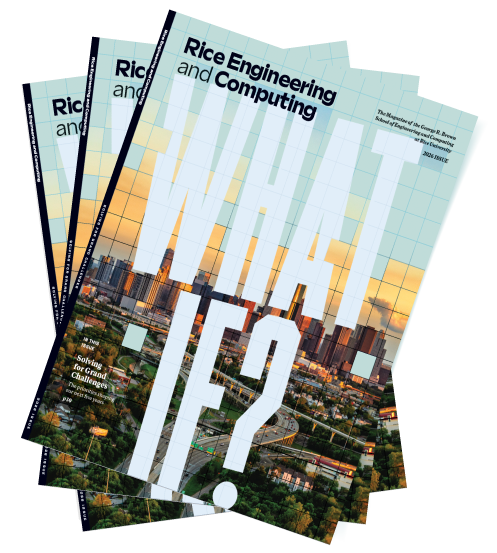
The 2026 issue of Rice Engineering and Computing Magazine is here!
This issue explores the ideas, people and partnerships shaping what comes next. Inspired by the momentum behind Vision 2030 — our school’s new strategic plan — this year’s stories highlight how our community is taking on big challenges in health and well-being, sustainability and resilience, and computing and AI. Inside, you’ll find a closer look at the research, collaborations and bold thinking driving Rice Engineering and Computing forward.
Diamond Owl Structure Offers New Ways to Cool Electronics
A keepsake in a Rice University lab has helped inspire a new approach to one of electronics’ most persistent challenges: overheating.
Researchers in the lab of Pulickel Ajayan, Benjamin M. and Mary Greenwood Anderson Professor of Engineering, created a tiny owl made of diamond as a gift for distinguished guests. In the process, they refined a technique for growing precisely patterned diamond structures — an advance that could help electronic devices run cooler and more efficiently.
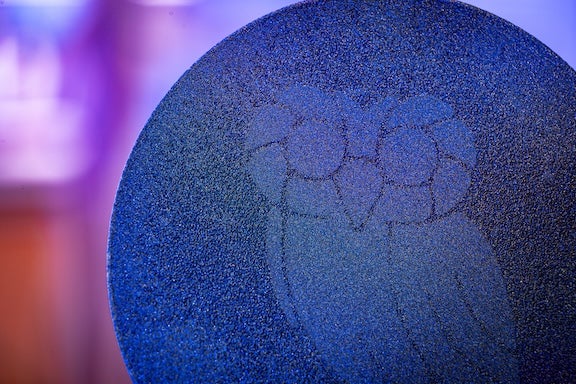
Today’s high-power technologies — from transistors used in radar and 5G devices to the processors supporting artificial intelligence — generate enormous amounts of heat. Diamond conducts heat better than many other materials, making it ideal for drawing heat away from hot spots in electronic devices. But its hardness and chemical resistance make it difficult to shape.
Instead of carving patterns into diamond — a slow process that can damage the material — the Rice team developed a “bottom-up” approach that forms the patterns as the diamond grows. In a plasma-based process, carbon-rich gases break apart and carbon atoms settle on a surface, assembling into diamond crystals. By placing tiny diamond “seed” points exactly where cooling structures are needed, the researchers can control where the diamond grows and how it forms. This approach allows patterned diamond features to be integrated directly onto materials commonly used in electronics.
The team demonstrated the technique on common electronic materials including silicon and gallium nitride and found the patterned diamond structures could reduce device temperatures by about 23 degrees Celsius.
“The main takeaway is that we have found a scalable, effective way to integrate diamond cooling into electronics,” said Ajayan, whose group has long studied diamond-based materials. “This matters because heat is what limits the battery life of your phone and the speed of your computer. By using diamond to cool these devices more efficiently, we can pave the way for faster, more reliable and longer-lasting technology.”