

The 2026 issue of Rice Engineering and Computing Magazine is here!
This issue explores the ideas, people and partnerships shaping what comes next. Inspired by the momentum behind Vision 2030 — our school’s new strategic plan — this year’s stories highlight how our community is taking on big challenges in health and well-being, sustainability and resilience, and computing and AI. Inside, you’ll find a closer look at the research, collaborations and bold thinking driving Rice Engineering and Computing forward.
Brain cancer researcher earns Sontag Foundation distinction
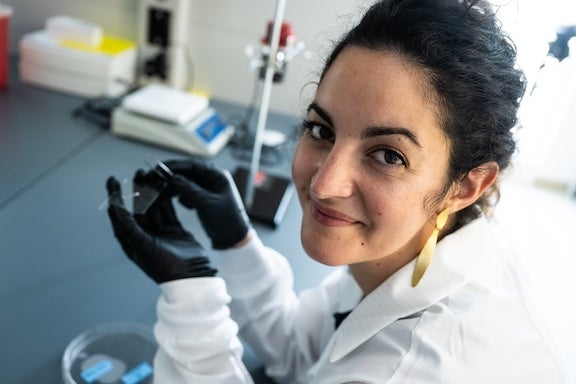
Christina Tringides, an assistant professor of materials science and nanoengineering, has been named a Distinguished Scientist by the Sontag Foundation, a national recognition for early-career researchers advancing transformative projects in brain cancer research. The award supports innovative work aimed at improving the understanding and treatment of some of the most difficult neurological diseases.
A member of the Rice Neuroengineering Initiative and a Cancer Prevention and Research Institute of Texas Scholar, Tringides studies and develops soft, tissue-like materials that behave like the brain. The Sontag award will support the development of Conductive Hydrogel Arrays with Multiple ELEctrodes Optimized for Neurons, or CHAMELEON, an array of soft, sensor-laden brain implants designed to improve how clinicians monitor and treat glioblastoma, the most common and aggressive form of adult brain cancer.
Tringides’ research group works with hydrogels, water-rich materials that mimic the softness and mechanical properties of brain tissue. Unlike conventional implants made from rigid materials commonly used in traditional electronics, hydrogels can better integrate with the brain, reducing tissue damage and improving long-term performance.
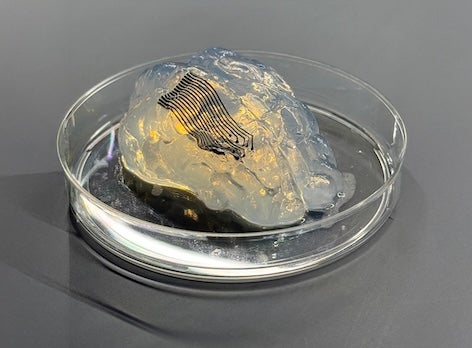
Currently, patients treated for glioblastoma typically undergo MRI scans every two months to determine whether tumors have returned following surgery. By monitoring neural signals directly within the brain, technologies like CHAMELEON could provide earlier insight into disease progression and enable more precise interventions.
The significance of neuroengineering research like Tringides’ is underscored by growing investment in brain health research. In Texas, voters recently approved the establishment of the Dementia Prevention and Research Institute of Texas, creating a $3 billion, 10-year initiative to accelerate discoveries related to Alzheimer’s disease and other neurological conditions.
For Tringides, whose work sits at the intersection of materials science, bioelectronics and neural engineering, the Sontag recognition reflects the promise of interdisciplinary research to transform how clinicians understand and treat diseases of the brain.