
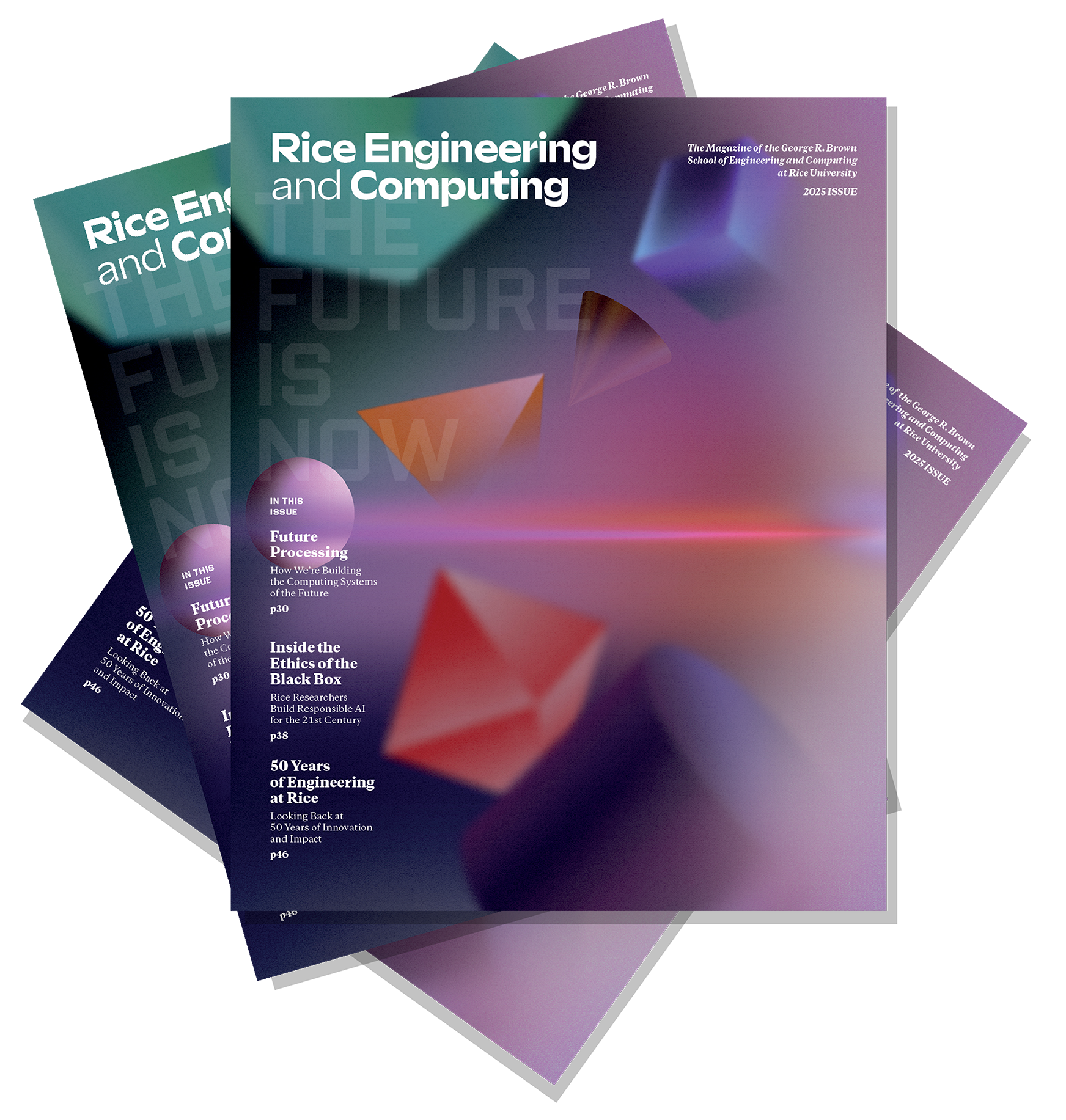
The 2025 issue of Rice Engineering and Computing Magazine is here!
In our 50th anniversary issue, we celebrate the deep and growing connection between engineering and computing. From our early breakthroughs in high-performance computing to today’s advances in AI and data science, Rice has long been at the forefront of computing innovation. This edition highlights some of the people, ideas, and investments shaping what’s next.

Water systems weren’t designed for the pressures they now face. Rice University is building the case and the technology for something fundamentally better.
Of all the resources the world depends on, none is under greater stress than water. In Houston, the pressures are unusually acute: a sprawling coastal city contending simultaneously with flooding, land subsidence, saltwater intrusion and the water demands of one of the world’s largest industrial economies. What happens here, in many ways, is a preview of what happens everywhere.
“Clean water can save more lives than doctors,” Pedro Alvarez, director of the Rice WaTER Institute and recipient of the 2026 Benjamin Franklin Medal in Civil Engineering, has said. It’s a provocative line, but the data backs it up. And it captures exactly the kind of thinking that animates the institute he leads.
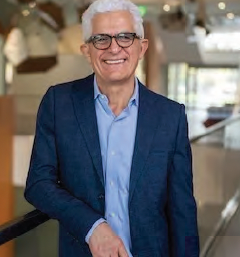
“It’s more of an innovation ecosystem,” says Menachem Elimelech, the institute’s lead researcher on water and energy and one of the world’s foremost authorities on water quality engineering and membrane technologies. “The core focus, at least on the technical side, is really about moving away from large, chemical-intensive water treatment plants toward more compact, modular and energy-efficient systems that can provide fit-on-demand treatment. The idea is to tailor the technology to the specific problem and design accordingly, rather than relying on large, centralized plants that aren't flexible.”
That vision didn’t emerge out of nowhere. The Rice WaTER Institute, launched in January 2024, grew directly out of the university's Nanotechnology Enabled Water Treatment Center known as NEWT, a $37 million, decade-long initiative funded by the National Science Foundation. Over ten years, NEWT produced more than 900 research publications, 45 patent disclosures and trained roughly 200 graduate students across 30 faculty labs at four universities.
NEWT didn’t end. It evolved. Its mission now continues through the NEWT Alliance, a multi-institution network with Rice at its center. The Rice WaTER Institute is both a continuation and an acceleration of the research and alliances that were built by NEWT. Its work is organized around three pillars, each targeting a different dimension of the global water crisis.
The first is water and public health, the threat posed by contaminants like PFAS, the “forever chemicals” that have become a defining environmental challenge of the past decade. But the institute’s public health mission goes beyond identifying threats. It is pushing toward a fundamental change in how water gets treated in the first place.
Much of today’s infrastructure, Elimelech points out, relies on approaches that haven't meaningfully changed in a century. “It's technology that has not changed in the last hundred years,” he says. “All these chemicals make it complicated. You get a lot of sludge. You need trucks to bring the chemicals.” The trajectory, he says, is toward less chemical-intensive, more energy-efficient approaches such as membranes, electrochemical processes and compact modular systems that can be tailored to specific needs.
The second pillar, and Elimelech's primary area of research, is the water-energy nexus. Producing water requires energy. Producing energy requires water. And as both resources come under increasing strain, the inefficiencies of the current paradigm become harder to ignore.
At the heart of Elimelech's work is the challenge of augmenting water supply through desalination and wastewater reuse and doing so in ways that are greener, more circular and less energy-intensive than existing approaches. Desalination inevitably produces brine, a highly concentrated byproduct that can't simply be discarded.
“We need to find some way to continue to squeeze all the water out,” he says, “so you're left with nothing. Just very, very concentrated, almost solid material.” Increasingly, that brine is being reconceived not as waste but as a resource. Magnesium and lithium can be recovered from these concentrates, while sodium chloride can be converted to produce acids and bases.
The lithium angle is particularly striking. In Texas oil and gas fields, vast quantities of brine come up alongside every barrel of crude. Elimelech’s group has found that these brines contain lithium in concentrations high enough to make recovery economically viable. The challenge is selectivity: separating lithium from chemically similar elements like sodium requires membranes of extraordinary precision. His reference point, characteristically, is biological. The potassium channel, a membrane structure in human cells, admits potassium while blocking the nearly identical sodium ion. “We are not as smart as nature,” Elimelech says, “but we are trying to mimic it.”
That same precision carries into the institute’s third pillar: resilient infrastructure. The vision is a departure from the centralized, aging systems most cities rely on—modular, autonomous treatment units capable of handling everything from brackish groundwater to high-salinity industrial wastewater. These systems are digitally integrated through sensors, AI-driven monitoring and digital twins. Houston, with its unique combination of industrial scale, climate vulnerability and civic complexity, is the living laboratory where these ideas get tested.
What distinguishes the WaTER Institute is not any single technology but rather the environment in which the work happens. Its collaborative structure and culture function as a competitive advantage. The institute draws on an unusually broad disciplinary base: materials science, data science, environmental policy and social science. That breadth is paired with a deliberate commitment to moving research into practice through industrial partnerships, federal funding and the startups that have already emerged from its predecessor.
Houston is not merely the setting for this work. It is the proof of concept, a test case for a model the institute believes can scale to other coastal cities, industrial centers and regions where the gap between the water available and the water needed keeps growing.
It’s necessary work, but Elimelech is clear-eyed about the pace of change. Water is not software, and new approaches can take years, sometimes decades, to reach widespread use. Even the most promising startups often need the better part of a decade before they have a market-ready product. In water, breakthroughs don’t announce themselves. They accumulate. For Elimelech, that's not a source of frustration. It’s simply the nature of the work. “You need to be patient,” he says. And in a field where the stakes are this high, patience isn’t a virtue so much as a requirement.