
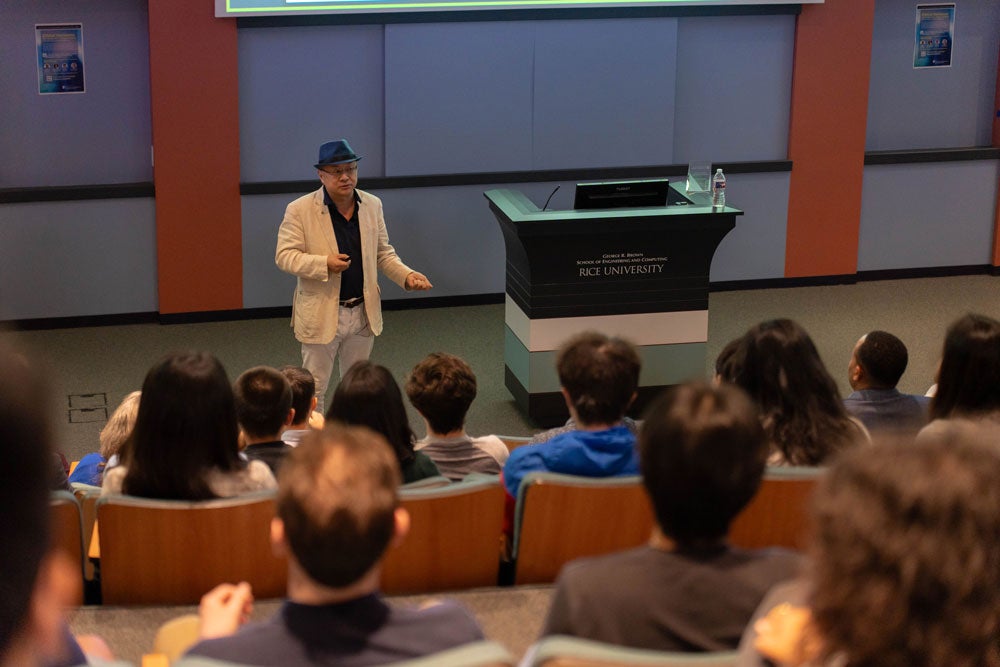
Xiao-Li Meng, the Whipple V. N. Jones Professor of Statistics at Harvard University, presented the 2026 James R. Thompson Distinguished Lecture, an annual lecture hosted by Rice University’s Department of Statistics, on Nov. 5. At the event, four doctoral students were also honored with James R. Thompson Student Awards in Statistics for their outstanding contributions to statistical and multidisciplinary research, and Rice’s educational mission.
Meng is the founding editor-in-chief of Harvard Data Science Review and has served as the dean of Harvard’s Graduate School of Arts and Sciences and the chair of Harvard’s Department of Statistics.
“We are thrilled to present Professor Meng, who has conducted foundational research in a variety of topics in statistics ranging from statistical inference and Bayesian methods to statistical computation, as the 2026 honoree of the James R. Thompson Distinguished Lecture Series,” said Luay Nakhleh, William and Stephanie Sick Dean of Rice’s George R. Brown School of Engineering and Computing, in his welcome address.
Established in 2018, the lecture series honors the career of the department’s founding chair, James Thompson, who contributed significantly towards statistical research and interdisciplinary applications, teaching, and mentoring. The series brings internationally recognized scholars in statistics to Rice to deliver talks on topics of broad interest and celebrates exceptional research and teaching achievements among the department’s emerging scholars. The lecture and student awards are supported by the James R. Thompson Memorial Fund, which is endowed through generous contributions from Thompson’s family, friends, and colleagues.
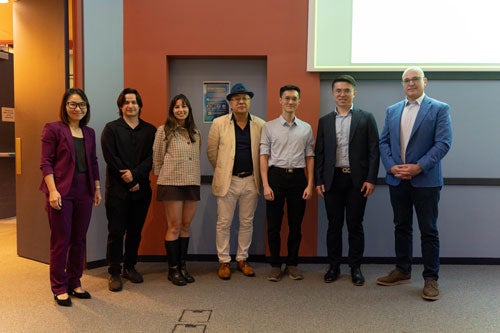
This year’s event began with a ceremony recognizing four emerging scholars with student awards.
2026 awardees:
Jose Palacio
For excellence in research in statistical public health and significant contributions to the National Wastewater Epidemiology Program and Rice’s educational mission.
Rose Graves
For excellence in research in sports analytics, community leadership and significant contributions to Rice’s educational mission.
2025 awardees:
Xin Tan and Ren-Yi Wang
For outstanding scholarship and research achievements as a doctoral student in statistics at Rice University.
The awards ceremony was followed by Meng’s lecture titled, “Privacy, Data Privacy, and Differential Privacy."
The lecture focused on the growing importance of protecting individual data privacy in an age of pervasive digital technologies and AI. Meng traced the concept of privacy from its origins as a late 19th-century legal right, spurred by tabloid harassment, to the challenges posed by today’s digital age. He then introduced differential privacy, a cryptography-based mathematical framework that balances data utility with individual privacy.
Meng explained how differential privacy works, injecting random noise into datasets helps ensure that the output of an analysis remains unchanged whether an individual’s data is included or excluded, protecting individual privacy at the potential cost of data accuracy. While this approach allows data scientists to identify useful, macro-level trends and patterns about a population, it limits how much can be definitively inferred about any specific individual. This highlights the central goal and paradox of the method — The more one knows, the less is left to protect.
He also noted that while differential privacy is useful, its privacy protections are not infallible. They can falter when adversaries exploit interdependencies among individuals to gather information, like how quarantining only symptomatic individuals fails to stop an airborne disease.
Meng concluded by urging researchers to look at the big picture in their data. Rather than studying pieces of information in isolation, he encouraged them to map how factors connect and influence one another.