
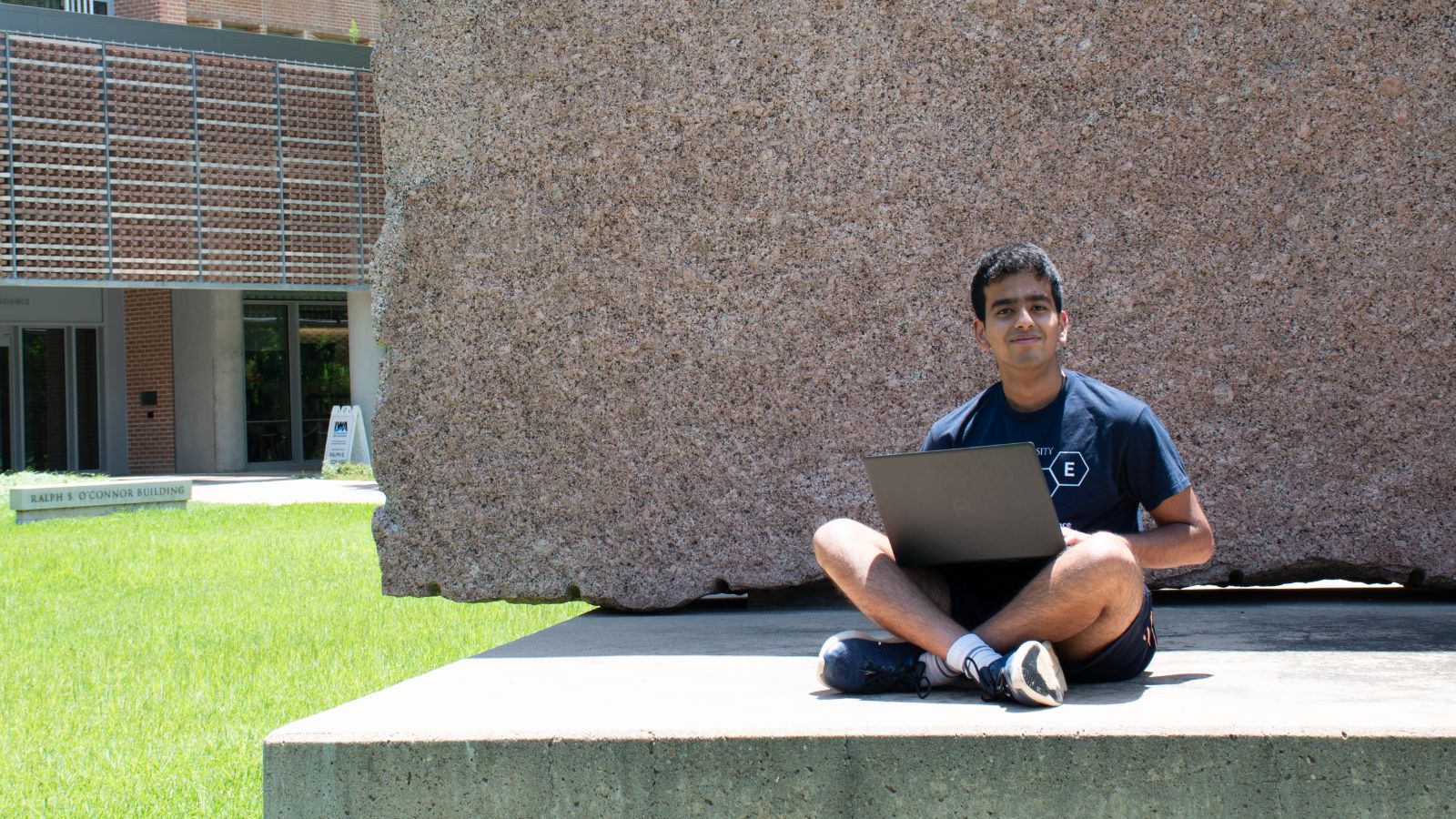
Rice University freshman Rishi Madhuvairy and Purdue University sophomore Rahul Prabhu earned first place in the poster competition at Purdue University’s AI Research Showcase on April 14, 2026, after developing an AI-driven model designed to detect defects in semiconductor wafers.
Semiconductor chip companies produce tens of millions of wafer defects on assembly lines every year. These mistakes put a significant strain on production and cost the industry millions of dollars in remediation capital annually. As the global semiconductor market is expected to top $1 trillion by 2027, more efficient defect detection systems are critical.
Rishi Madhuvairy, a student in materials science, came to Rice with a deep motivation to solve real-world problems through hands-on research. When an opportunity was presented to collaborate on a solution for semiconductor chip defect detection, he embraced the challenge.
In their recent paper, “Fusing Handcrafted Spatial Descriptors with a Lightweight CNN for Semiconductor Wafer Map Defect Classification,” Madhuvairy and Prabhu describes how their model classifies processing defects in 2D semiconductor wafers and traces where they originate in the manufacturing process.
“The premise for our entire project was to create a way to automate the prediction and classification of these defects that occur on a regular basis,” said Madhuvairy. “Our model could further be integrated into a yield intelligence platform that can tell quality control engineers where and how, spatially speaking, defects are arising in silicon wafers.”
While current state-of-the-art defect detection technology uses complex algorithms with data processed offsite, Madhuvairy and Prabhu propose a high-accuracy, low-latency model that can be implemented onsite within the lab. A unique aspect of the model is its use of eight spatial descriptors that identify where defects appear on the wafer and whether they occur in clusters or isolation.
By introducing these spatial descriptors and training a convolutional neural network—a deep learning model designed for processing visual data—they identified and classified semiconductor defects with nearly 13% more accuracy than the basic computer vision model.
“Combining statistics with computer vision models is not new,” said Prabhu. “But applying it to semiconductor defect classification with this kind of industry dataset is.”
Interdisciplinary collaboration was key to the success of this project. “I came to this project not knowing much about the computer vision aspect,” said Madhuvairy. “I brought the theoretical knowledge of spatial classification, but to apply it in a commercial use model, then you need skills to develop the vision model. Rahul’s expertise really came through as he took the reins of that part of the project, and I learned a lot from him.”
Long-term plans for their project include elevating the capacity of their current model, integrating their model into a physical setup, and exploring pathways to commercialization.
For Madhuvairy, this semiconductor vision model project is rooted in his passion for device physics that traces back to his first research project in theoretical nanophotonics he completed while in high school at the Indian Institute of Science. His desire to optimize devices with his hands led him to declare a major in materials science at Rice University.
“Materials science sits at the intersection of nearly every engineering and scientific field,” said Madhuvairy. “Whether you’re working in electrical engineering or AI, you need to have an understanding of materials science to manipulate properties of devices at the nanoscale.”
As Madhuvairy completes his freshman year at Rice, he has a number of other projects on the horizon, with applications ranging from renewable energy to wearable medical devices. This summer, Madhuvairy will work alongside Dr. Alessandro Alabastri as a Rice Advanced Materials Institute (RAMI) undergraduate fellow.
“Students like Rishi reflect the standard we are setting in the department of materials science and nanoengineering,” said Karen Lozano, Trustee Professor of Materials Science and NanoEngineering and department chair. “Even as a freshman, Rishi is already thinking beyond the lab and toward real-world impact. His work demonstrates the kind of interdisciplinary thinking and translational mindset that define the department.”