
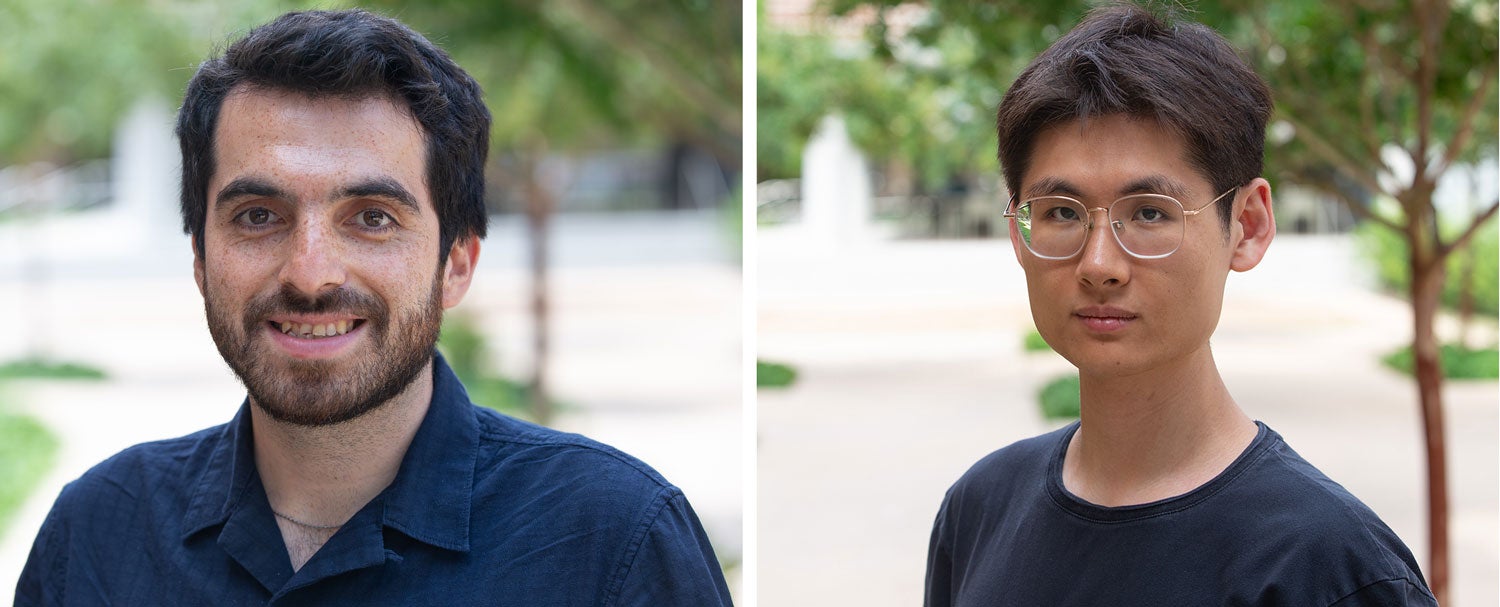
Raul Garcia (left) and Jiaming Liu (right)
Two doctoral alumni from Rice University’s George R. Brown School of Engineering and Computing, Raul Garcia and Jiaming Liu, have secured competitive postdoctoral fellow positions after completing the school’s Future Faculty Fellows (FFF) Program. Both researchers credit the program in preparing them for successful careers in academia by connecting them to faculty mentors and professional development resources.
Advancing Cancer Screening Guidelines
Raul Garcia completed his Ph.D. under the mentorship of Andrew Schaefer in Rice’s Department of Computational Applied Mathematics and Operations Research. He joined MD Anderson Cancer Center as a postdoctoral fellow in the Department of Health Services Research.
Garcia’s doctoral research applies advanced mathematical optimization models to design realistic, patient-centric public health screening guidelines for lung cancer. While frequent lung cancer screening catches disease early, it can also lead to higher healthcare costs, elevated false-positive rates, and unnecessary invasive diagnostic procedures. Although a few personalized screening models have been developed, they are often difficult to interpret and implement in clinical practice. As a result, screening often relies on traditional population-based, or one-size-fits-all, strategies that can overestimate the real-world benefits of screening by assuming perfect patient compliance. The success of these models relies on shared decision-making between patient and physician to balance benefits and harms.
To address this gap, Garcia developed a framework that integrates bilevel optimization models within a sequential decision-making process involving public health agencies, which establish screening guidelines, and individual patients, whose decisions and behaviors influence how those guidelines work in practice. By accounting for patient behaviors and incentive structures that improve guideline adherence, the framework enables practical, population-level screening strategies that can optimize health outcomes for each patient.
“I am humbled to have been selected a Future Faculty Fellow,” Garcia said. “It meant a lot to have the faculty and staff at Rice believe in my potential to be a faculty member, and I’m grateful for their dedication to helping me achieve that goal. Over the years, I learned a great deal from the FFF workshops — from how to present my research to understanding the application process and networking. I also benefited greatly from the personalized feedback I received from the faculty on my application documents. Their feedback helped me understand how future employers will evaluate my work, pushing me to think deeper about my research plan and articulate it better. I’m also thankful to this program for a travel stipend to attend, network and present a poster at the 2026 Mixed Integer Programming Workshop.”
Scaling Trustworthy AI and Machine Learning
Jiaming Liu completed his doctoral degree from Rice’s Department of Statistics under the guidance of Meng Li and recently joined the Data Science Institute in the University of Chicago as a postdoctoral researcher.
His doctoral research focused on developing trustworthy and computationally efficient Bayesian methods for statistical inference and machine learning, particularly in settings involving complex models and large-scale data. A central challenge in modern statistics and AI is that while computational methods can produce accurate predictions, they do not always provide reliable measures of uncertainty.
Liu’s research aimed to bridge this gap by developing uncertainty quantification methods that make Bayesian inference both scalable and trustworthy. He used a combination of statistical theory and computational methods to improve the reliability of uncertainty estimates without sacrificing computational efficiency — factors that are particularly relevant as complex AI and machine learning models are increasingly adopted in scientific research and decision-making.
“Participating in the Future Faculty Fellows Program was one of the most incredibly valuable experiences during my time at Rice,” Liu said. “It brought together graduate students and postdocs from different research backgrounds and created a supportive environment where we could exchange ideas, learn from one another, and grow both academically and professionally. One of the most meaningful aspects of this program was the mentorship and practical guidance I received from faculty members. From refining my curriculum vitae and application statements to preparing me for interviews through mock interview sessions, they helped me better understand the academic job market and approach it with greater confidence and I’ll always be thankful for that.”
To learn more about the Future Faculty Fellows Program and to apply for it, click here.