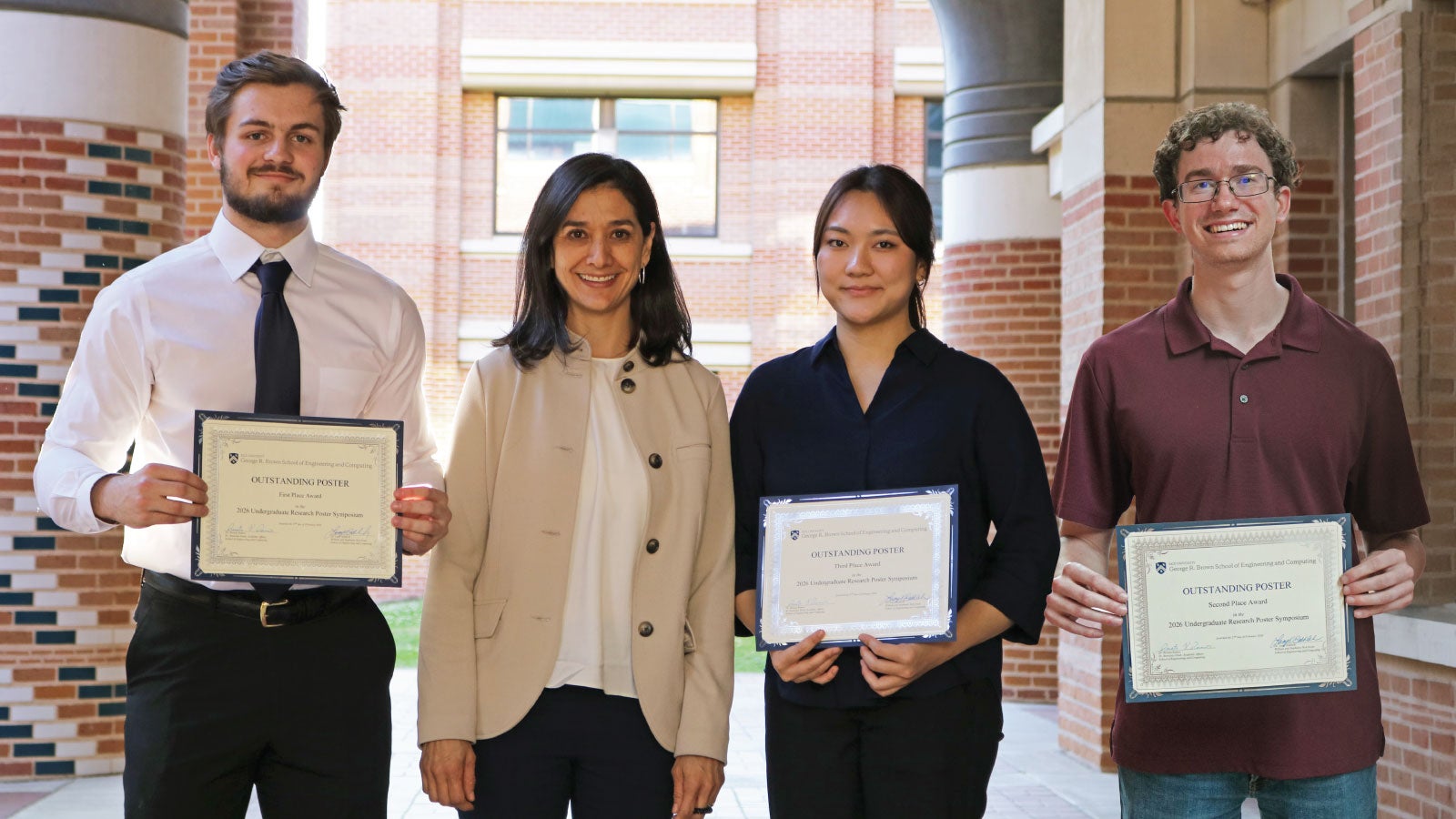
L to R: Tyler Neilson, Prof. Renata Ramos, Ellena Jeon, and Joseph Wright.
Photo credit: Mika Chang and Lucero Hernandez.
Rice University's George R. Brown School of Engineering and Computing held its second annual undergraduate research symposium at Martel Hall on Feb. 27, 2026. Forty-eight Rice engineering undergraduates, representing the school’s nine departments, presented scientific posters on the interdisciplinary research they were conducting under the guidance of the school’s faculty, graduate students and postdoctoral fellows. Several projects also involved collaborations with researchers from other schools in Rice and Texas Medical Center’s research institutions.
The posters aligned with the school’s mission of ‘Solving for Greater Good,’ and focused on one or more of the school’s five strategic research areas: resilient and adaptive communities, advanced materials, health and well-being, energy and sustainability and future computing.
Renata Ramos, the school’s Senior Associate Dean for Academic Affairs presented awards for outstanding research posters. Addressing the participants, Ramos said, “Congratulations to all the students who participated in this research symposium today. We are impressed by the breadth and the quality of research on display here and extremely proud of the hard work, creativity, and collaborative spirit you’ve demonstrated.”
Tyler Neilson, a freshman majoring in bioengineering, won the first-place award. He was mentored by Michael King, E.D. Butcher Professor of Bioengineering, and Melissa Cantu, a graduate student at Rice. Neilson's poster explored an experimental method to produce and activate CAR T-cells—engineered immune cells used to treat difficult blood cancers like leukemia, lymphoma, and multiple myeloma—more affordably and at scale. Current methods to produce CAR T-cells are incredibly slow and costly, limiting access to therapy. Neilson and his collaborators repurposed a 96-channel electronic pipetting system to produce large volumes of viable CAR T-cell. The process improvement could help shift CAR T-cell therapy from a specialized, high-cost laboratory procedure performed at only a few leading medical centers to a faster, more affordable and widely accessible treatment.
Joseph Wright, a sophomore majoring in mechanical engineering, won the second-place award. He was mentored by Denizhan Yavas, assistant teaching professor, and Daniel Preston, assistant professor of mechanical engineering at Rice. Wright’s poster explored two adhesive-free design strategies to create strong bonds between components in soft robotics and wearable devices. Soft robots rely on seamless integration between soft and hard components but standard adhesives fail under intense pressure, heat, or repeated stretching. Inspired by bone-tendon interfaces, Wright and collaborators 3D-printed rigid resin lattices filled with elastomer to create a transition zone where components such as a touch-sensitive dome and biomimetic finger physically interlock at a microscopic level without glue. They also introduced wavy interfaces between different types of silicone to improve flexibility and movements. Together, these approaches could help produce soft robots that are both durable enough for demanding tasks and capable of delicate, human-like motion.
Ellena Jeon, a junior majoring in bioengineering, won the third-place award. She was mentored by Antonios Mikos, Louis Calder Professor of Bioengineering and Chemical and Biomolecular Engineering at Rice; postdoctoral fellow Vasiliki Kolliopoulos, and MD/PhD student Maeve Kennedy. Jeon’s poster explored how to make 3D-printed scaffolds for bone regeneration stronger and more effective by refining how they are produced. To create tougher, patient-centric supports, Jeon and researchers in the Mikos lab studied how 3D-printing parameters and polymer properties affect the molecular structure of poly(ε-caprolactone) or PCL, a flexible, biodegradable plastic commonly used in tissue engineering.
The symposium was sponsored by Chevron.