
How does artificial intelligence change public trust in companies and governments? What makes assistive technology truly useful to people with disabilities? And how can governments regulate AI while remaining technologically competitive?
Rice University undergraduates explored these questions and more through the Undergraduate Summer Research in Technology and Responsibility program at the George R. Brown School of Engineering and Computing. Supported by Nancy S. Dunlap, the program gave students an opportunity to come together and investigate the ethical and social implications of emerging technologies from multiple disciplinary perspectives.
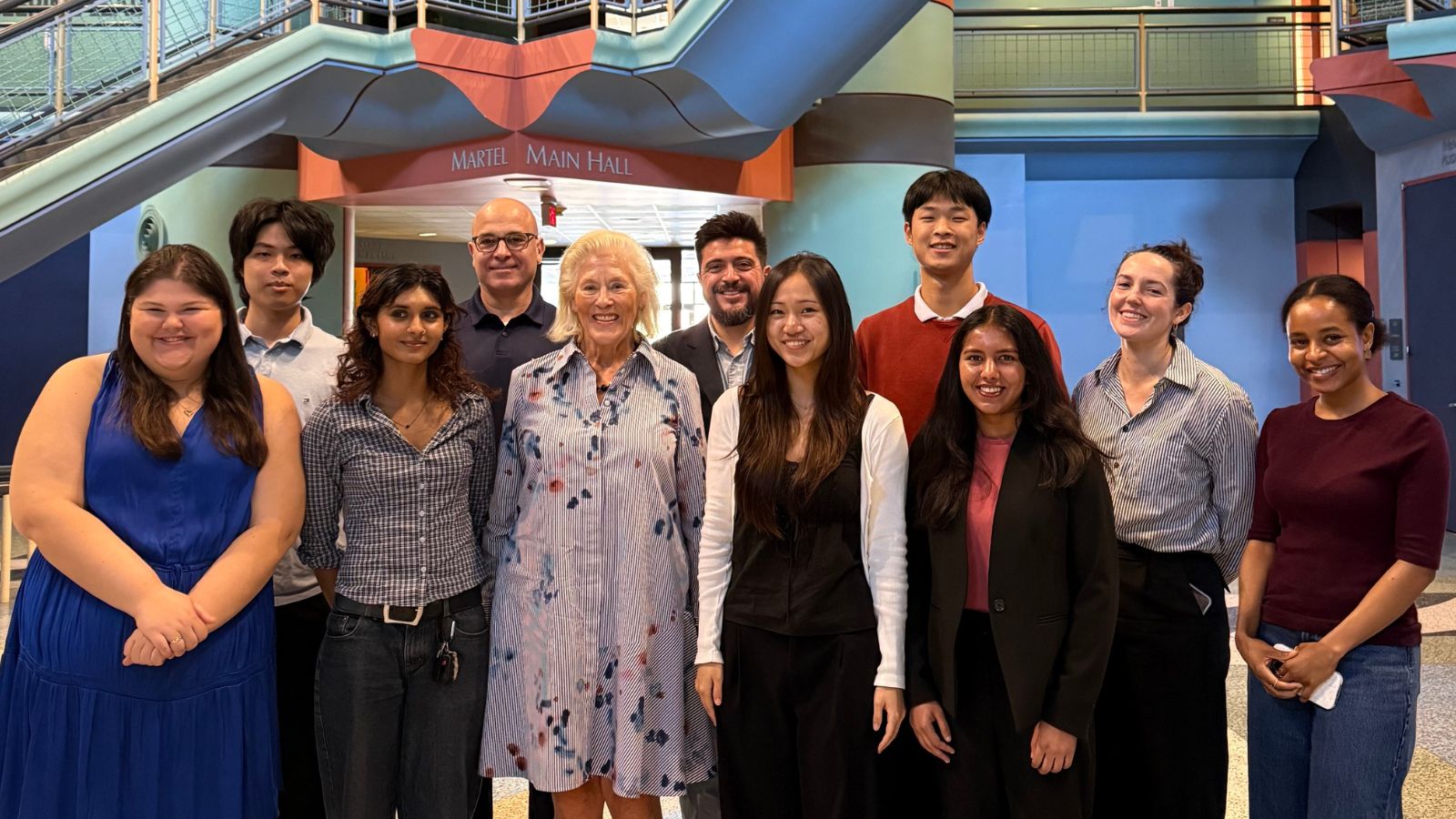
Dunlap joined Luay Nakhleh, William and Stephanie Sick Dean of Engineering and Computing, and Rodrigo Ferreira, associate teaching professor of computer science and associate dean for technology and responsibility, on campus to hear students present their summer research. Program mentors Katherine Shwetz (Medical Humanities) and Khadija Zanna (ECE) also attended the showcase.
“The theme of this year’s program was ‘Tech, Trust, and Trustworthiness,’” Ferreira explained. “Emerging technologies are today transforming health industries, labor markets, and governance strategies, among many others. But people may not trust, often with good reason, that these changes always have their best interest in mind. So, when creating tech that aims to solve for greater good, an important question then becomes: How do we design technologies that are not only trustworthy but also can help inspire trust when that trust is due?”
The projects spanned engineering, computing, health care and public policy, reflecting the importance of interdisciplinary perspectives in addressing complex social and technological challenges.
Suhani Koppolu, a neuroscience and medical humanities student, examined how age, disability and cultural differences shape the definition of successful dressing assistance. Her research, led by Dr. Vanessa Sanchez (MECH) with support from the Medical Humanities Research Institute (MHRI), explored how soft wearable robotics could better support people with disabilities. She is developing evaluation frameworks that account for users’ lived experiences and individual needs.
“Successful assistive technology means more than whether a device works technically,” Koppolu explained in her project summary. “It also means understanding what independence, autonomy and dignity look like for the people who use it.”
Elise Wang, a biosciences and medical humanities student, and Shreeya Madhavanur, a business and medical humanities student, both students working on projects led by MHRI, investigated how patients perceive the trustworthiness of AI in health care. Working with mentors from Rice and Baylor College of Medicine, they developed an interview guide exploring patient perspectives on autonomy, transparency, accountability, privacy and data use. Their research aims to ensure patients have a voice in shaping how AI is used in health care.
Other students studied responsible AI from technical and policy perspectives. Ryan Shen, working under the guidance of Dr. Akane Sano (ECE), explored how AI could help interpret legal and regulatory requirements. He developed a framework combining rule-based methods with large language models to extract and verify information from lengthy policy documents.
Denise Walsh, a senior studying political science, examined AI governance and U.S.-Mexico relations. Her research looks at how the United States, the European Union and Mexico approach the challenges of balancing technological competitiveness, national sovereignty and public protection.
Harvey Chen, working on a project led by Dr. César A. Uribe and Dr. Santiago Segarra (ECE), analyzed how AI can connect different occupational classification systems. He developed a tool that compares job tasks across systems to identify relationships between occupations. The work could help improve how jobs are categorized and how workforce training and career pathways adapt to a changing labor market.
Together, the projects explored a common question: How can emerging technologies be developed and used in ways that account for the people and communities they affect?
“It was inspiring to see the students share what they’ve been working on and how thoughtfully they’re approaching these challenges,” said Dunlap. “I’m happy to support a program that gives them the chance to study how technology can make a difference in people’s lives. I hope they carry that sense of purpose with them as they continue their studies and careers.”
“Bringing together students with different academic backgrounds helps us see challenges from multiple perspectives,” Ferreira said. “By engaging with questions of ethics, policy, health and human experience, students learn to consider not only whether a technology works, but also how it can have an impact on people’s trust and broader sociotechnical systems.”