
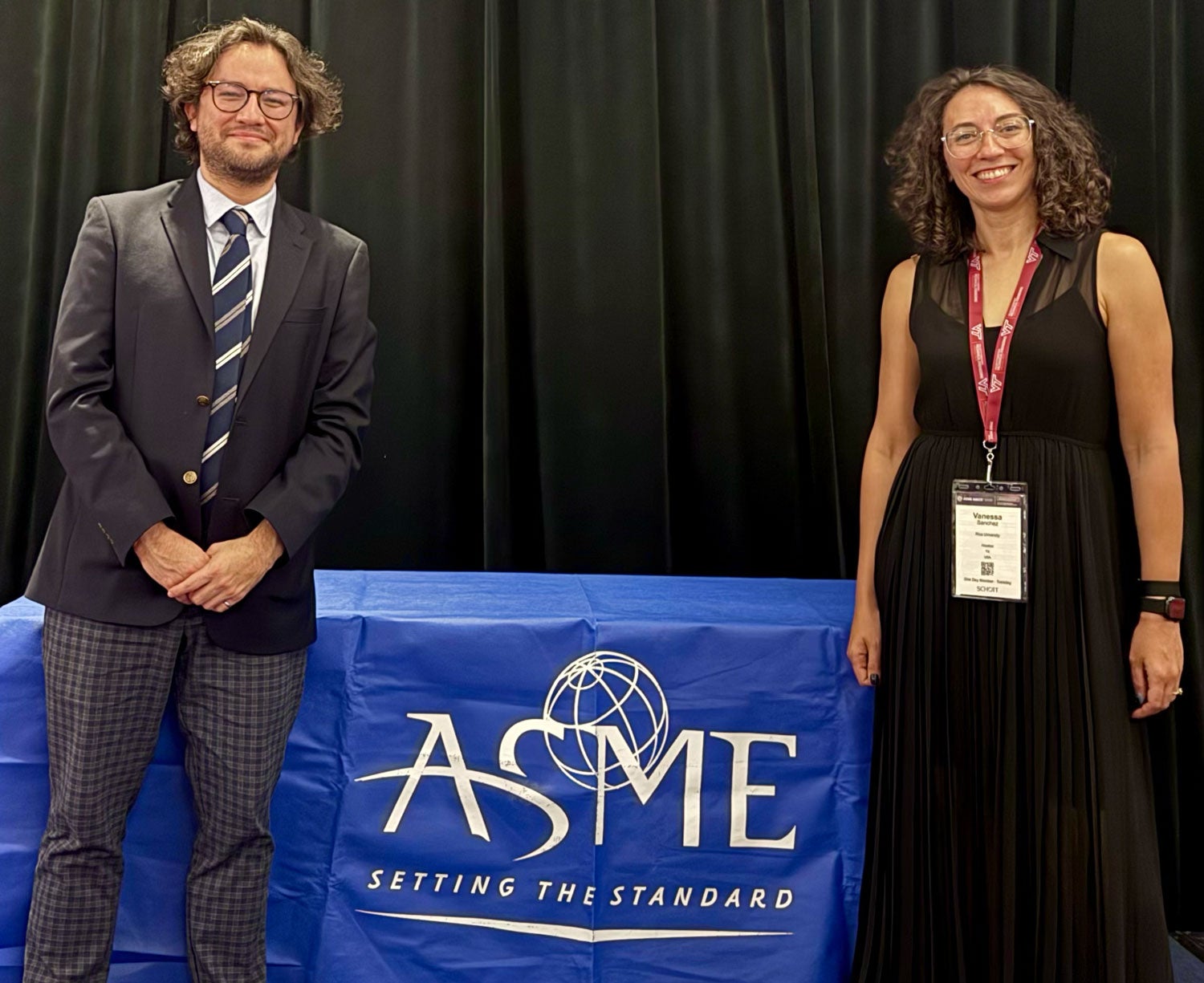
Raudel Avila (left) and Vanessa Sanchez (right)
Two faculty members in the Department of Mechanical Engineering at Rice University’s George R. Brown School of Engineering and Computing were honored at the American Society of Mechanical Engineers (ASME) Applied Mechanics Division Banquet held in Vancouver on Nov. 10, 2026.
Assistant professor Raudel Avila received the 2026 Journal of Applied Mechanics Award, which recognizes outstanding work by early-career researchers. Assistant professor Vanessa Sanchez received the 2026 Haythornthwaite Research Initiation Grant, which supports early-career faculty exploring new research directions in applied mechanics.
2026 Journal of Applied Mechanics Award
Raudel Avila received the 2026 Journal of Applied Mechanics Award for a perspectives paper published in the Journal of Applied Mechanics examining the rapidly advancing field of bioresorbable electronics. Rice mechanical engineering students Pei Liu, Chihtong Lee, and Nicole Carusetta were also co-authors on that paper.
Avila’s research advances dissolvable implantable electronics—such as pacemakers—that can safely dissolve into the body when no longer needed, eliminating the need for a second surgical procedure to remove them. By merging engineering, materials science, and medicine, his work addresses the fundamental challenge of designing sturdy, reliable electronics that can stretch, bend, and respond to forces within the body while gradually degrading over time. Beyond clinical applications, bioresorbable electronics also have potential applications in precision agriculture through environmental sensors that track soil moisture and other properties.
“We’re rethinking a long-standing assumption in electronics engineering, which is to ensure durability and permanence,” said Avila. “By advancing research in bioresorbable electronics, we can control not only how a material performs but also how that performance evolves over time, opening new possibilities for technologies whose legacy lies in the purpose they serve, not their permanence. I’m thankful to ASME for recognizing my contributions to this emerging field of research.”
2026 Haythornthwaite Research Initiation Grant
Vanessa Sanchez received the 2026 Haythornthwaite Research Initiation Grant to support her research on the mechanics of how fibers in fabrics unravel. Her goal is to design adaptive, sustainable materials and systems that can be systematically disassembled after use.
By understanding how to separate individual threads of a fabric while keeping them intact, her research could enable fabrics that can be rewoven and reused for different purposes. Sanchez envisions that the impact of her work will extend beyond everyday clothing and household items to include reusable wearable health devices and soft robotic materials tailored for resource-constrained space environments.
“Correctly identifying, sorting, and recycling our clothing is already an onerous task, and the increasing popularity of wearable health tracking devices that have electronic components makes soft material recycling even harder. So, we are designing fabrics and soft materials where controlled unraveling of their fibers is a built-in feature, not a bug to be avoided,” said Sanchez. “I’m grateful to ASME for supporting this new direction of research, which will help us develop soft fabrics and materials that are not locked into a single state permanently but can be unraveled and reused, feeding a circular economy.”