
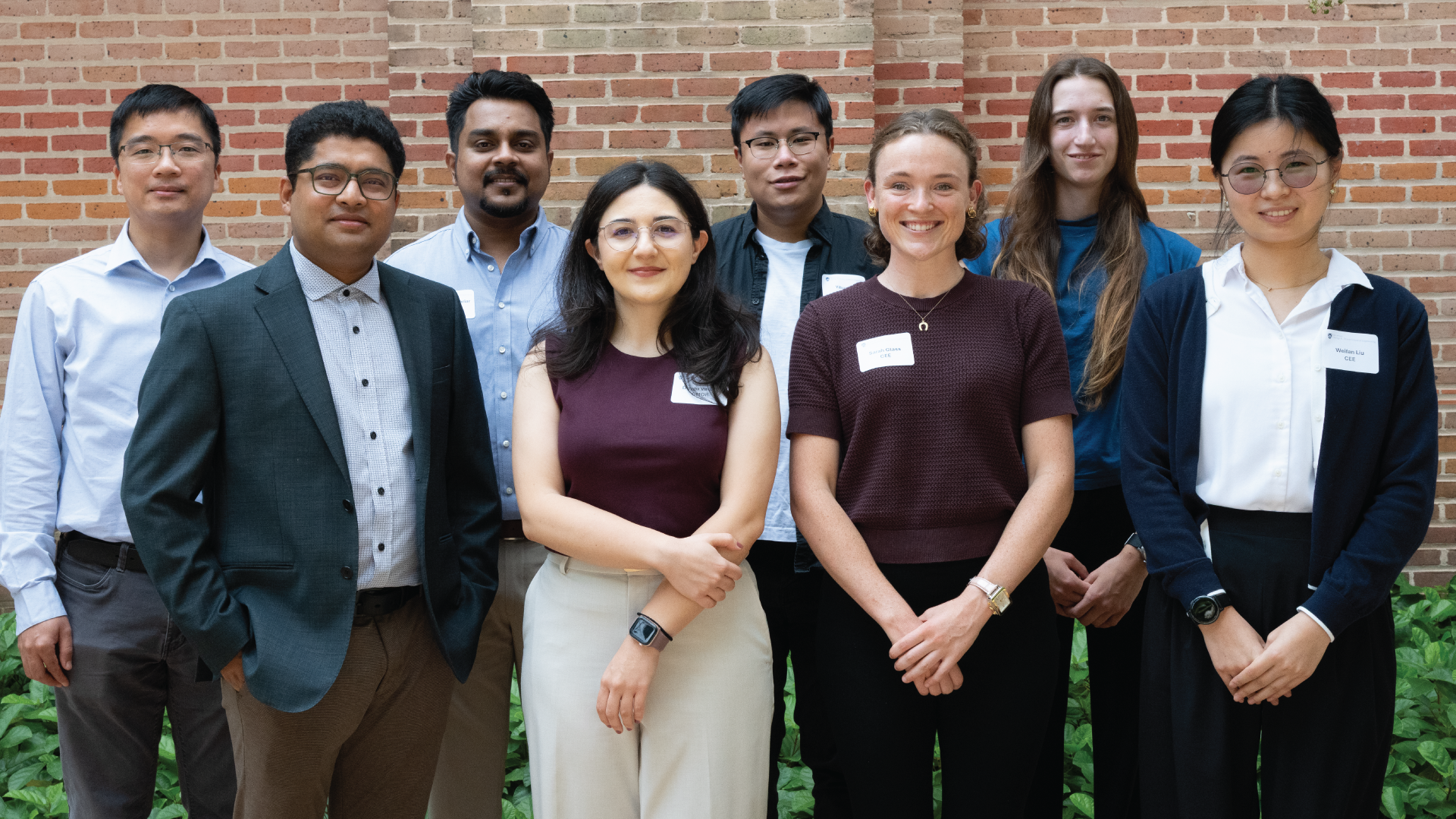
Front (L-R): Arka Chatterjee, Duygu Vargun, Sarah Glass and Weifan Liu.
Back (L-R): Thai Duong, Md Abid Shahriar Rahman Saadi, Yihua Xu and Ria Stevens.
Not pictured: Rose Graves, Shalini Pandey and Lei Zhang.
Eleven graduate students and postdoctoral trainees in Rice University’s George R. Brown School of Engineering and Computing have been selected to participate in the 2026-27 Future Faculty Fellows (FFF) program. The fellows are selected based on their strong commitment and potential to make a positive impact on research, teaching and mentorship.
Entering its seventh year, the program prepares fellows for academic careers with one-on-one consultations, tailored workshops, and mock interviews. Workshops and panels are led by Rice University’s Activate Engineering Communication Program, the Center for Teaching Excellence, and Rice Engineering and Computing faculty.
We are excited to welcome this year’s cohort of Future Faculty Fellows. Building a successful academic career requires a supportive network. With this program, we provide a nurturing environment for the scholars to cultivate and deepen meaningful relationships with peers and faculty mentors who can guide them through every stage of their job search and equip them with the skills they need to secure a faculty position and excel in that career path.
— Renata Ramos, Senior Associate Dean for Academic Affairs, Rice’s School of Engineering and Computing
Meet the 2026-2027 Future Faculty Fellows
Postdoctoral Associates
- Arka Chatterjee in the Department of Electrical and Computer Engineering is developing a high-efficiency quantum light source and a new quantum materials platform to advance quantum technologies under Prof. Shengxi Huang’s mentorship. He earned a Ph.D. in physics from S.N. Bose National Centre for Basic Science and Jadavpur University, India, in 2021. He received the Department of Science and Technology (DST)-INSPIRE Fellowship from the Indian government in 2017.
- Thai Duong in the Department of Computer Science integrates robot learning, planning and control to develop efficient and reliable autonomous robotic systems under Prof. Lydia Kavraki’s mentorship. Duong earned his Ph.D. from University of California, San Diego in 2024. He was named a 2026 Robotics: Science and Systems Pioneer. In 2025, he received the Best Paper Award from the IEEE RAS Technical Committee on Robot Control and an Honorable Mention for the IEEE Transactions on Robotics King-Sun Fu Memorial Best Paper Award.
- Weifan Liu in the Department of Civil and Environmental Engineering develops membrane and electrochemical systems for mineral recovery under Prof. Menachem Elimelech’s mentorship. She earned a Ph.D. in environmental engineering from Vanderbilt University in 2025. She received Provost’s Pathbreaking Discovery Award from Vanderbilt University in 2025, and in 2026 earned the Jacobs Engineering Group/AEESP Outstanding Doctoral Dissertation Award and CAPEES-Elsevier Thesis/Dissertation Award.
- Shalini Pandey, in the Department of Bioengineering develops smart surfaces that are useful for creating new types of medical implants, drug delivery systems, and to improve the electrochemical sensors used in continuous monitoring and diagnostic devices under Prof. Omid Veiseh’s mentorship. She earned an integrated Ph.D. in chemistry from the Indian Institute of Science Education and Research (IISER), India, in 2021. She received IISER’s Academic Excellence Award and Best Teaching Assistant Award in 2017.
- Duygu Vargun in the Department of Computational Applied Mathematics and Operations Research models fluid movements in blood vessels and tissues to facilitate precise planning of cancer treatments under Prof. Beatrice Riviere’s mentorship. Vargun earned her Ph.D. in mathematical sciences from Clemson University in 2023. She has received the Michael Case Award for Outstanding Promise in Computational Mathematics and several travel awards and grants from various professional societies.
- Lei Zhang in the Department of Materials Science and NanoEngineering and the Rice Advanced Materials Institute uses physics-driven simulations to design electro-ceramics and semiconductors for renewable energy and electronic systems, under Prof. Geoffroy Hautier’s mentorship. Zhang earned a Ph.D. in material sciences and nanoengineering from the Georgia Institute of Technology in 2020 and received the ORISE ASTRO fellowship from Oak Ridge National Labs in 2019.
Ph.D. Candidates
- Sarah Glass in the Department of Civil and Environmental Engineering explores the effectiveness of catalytic materials and processes in degrading PFAS and other contaminants. She is advised by Profs. Pedro Alvarez and Bezawit Getachew. Glass earned her B.S. in chemical engineering from Louisiana State University in 2022. Glass received an Expanding Horizons Fellowship in 2023 from Rice University. In 2026, she received the Purdue University Trailblazers in Engineering Fellow award and the Hershel M. Rich Invention Award from Rice University.
- Rose Graves in the Department of Statistics is developing mathematical predictive models for applications in sports analytics and environmental conservation. She is co-advised by Profs. Marina Vannucci and Scott Powers. Graves earned a B.S. in statistical science from Duke University in 2020. She received the Ken Kennedy Institute Recruitment Fellowship in 2022.
- Md Abid Shahriar Rahman Saadi in the Department of Materials Science and NanoEngineering uses natural polymers to develop high-performance materials for energy, healthcare, food and structural engineering sectors. He is co-advised by Profs. Mohammed Maksud Rahman and Pulickel Ajayan. Saadi earned his M.S. in mechanical and aerospace engineering from George Washington University in 2020. He was named the 2026 NextProf Nexus Fellow by the University of California Berkeley, Georgia Institute of Technology and University of Michigan.
- Ria Stevens in the Department of Computer Science develops computational models to understand the theoretical foundations and limits of machine learning, including how its capabilities change when information is constrained or enhanced. She is co-advised by Profs. Maryam Aliakbarpour and Tasos Kyrillidis. Stevens earned a B.S. in computer science and statistics from McGill University in 2022. She received the Andrew Ladd Memorial Fellowship for Excellence in Computer Science from the Ken Kennedy Institute in 2025.
- Yihua Xu in the Department of Computational Applied Mathematics and Operations Research develops advanced mathematical and computational models to help decision-makers account for uncertainty in healthcare operations, service systems and resource allocation. He is advised by Prof. Sebastian Perez-Salazar. Xu earned a B.S. in mathematics, and a B.S. in history, technology, and society from the Georgia Institute of Technology in 2022. He received the Shell Graduate Fellowship from the Ken Kennedy Institute in 2024.