
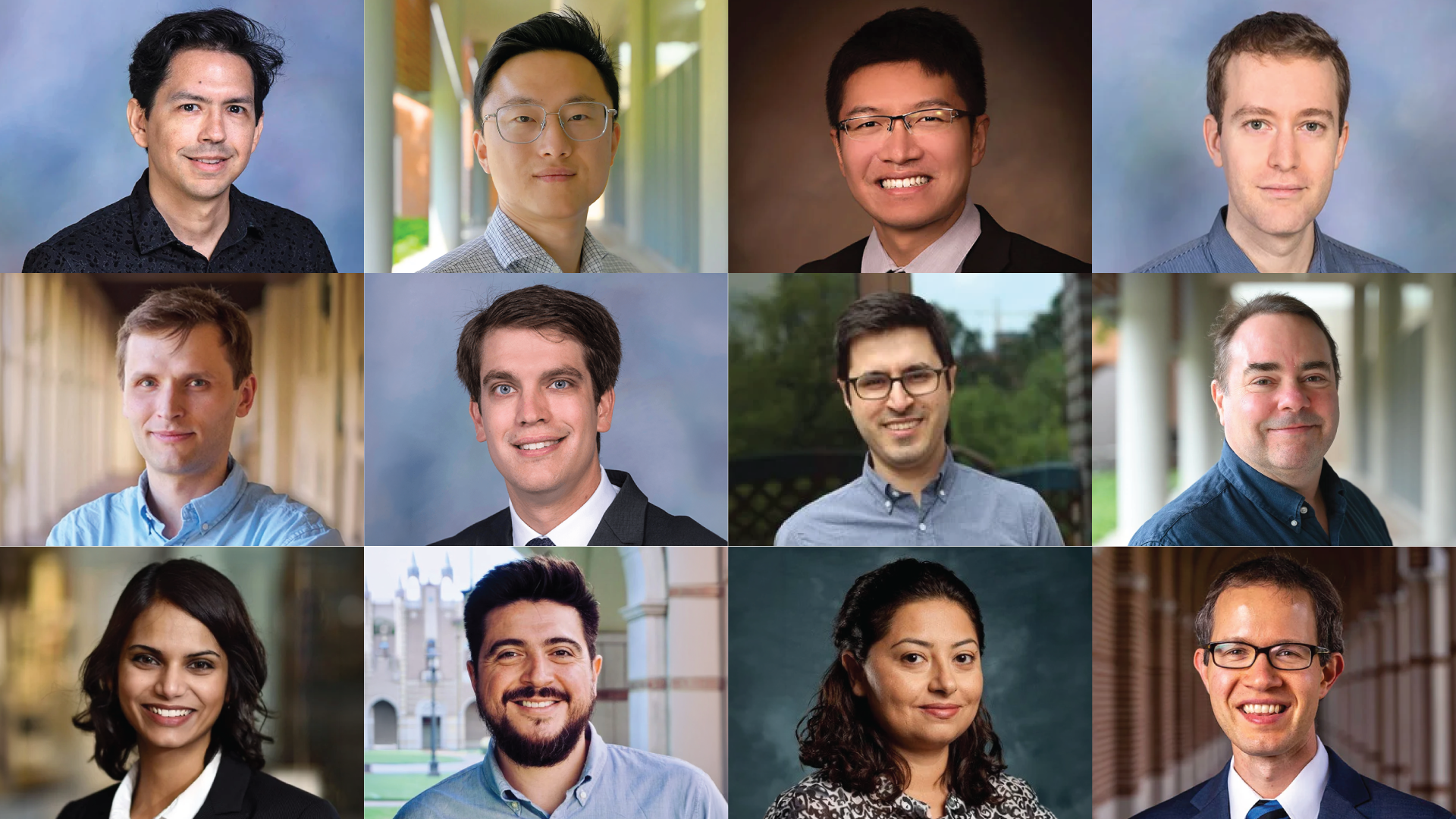
Twelve faculty members from the George R. Brown School of Engineering and Computing have been promoted to higher academic ranks in recognition of their outstanding contributions to research, teaching, mentorship and service. All appointments take effect July 1, 2026.
"It is a joy to recognize the remarkable achievements of our faculty, and I am deeply grateful for their dedication to our students and their respective fields of study,” said Amy K. Dittmar, Howard R. Hughes Provost and executive vice president for academic affairs. “These promotions reflect our collective commitment to transformative teaching, rigorous research and meaningful service that truly make a difference. The intellectual curiosity and academic freedom that drive our faculty are the fuel for Rice’s success and its broader contributions to the world.”
"One of the things that makes our school special is that excellence takes many forms," said Luay Nakhleh, William and Stephanie Sick Dean of Engineering and Computing. "Among this year's promotions are researchers driving discovery, educators transforming how students learn, and faculty leaders building programs that strengthen our community. Together, they represent the breadth of talent and impact that drives our school forward."
Promoted to Full Professor:
Vicente Ordoñez Román in the Department of Computer Science builds visual, facial and motion recognition and machine learning models that help computers understand complex visual information. His research spans multimodal AI, machine learning fairness and generative modeling, including advances in automated image captioning and text-to-image generation.
Haotian Wang in the Department of Chemical and Biomolecular Engineering develops catalytic materials and green process technologies for sustainable fuel production and chemical synthesis, energy storage, battery recycling, water treatment, and agriculture. He pioneered a cost-effective porous solid-electrolyte reactor that enables continuous direct air carbon capture and the scalable, environmentally friendly production of industrial chemicals.
Promoted to Associate Professor with Tenure:
Yong Lin Kong in the Department of Mechanical Engineering creates nanomaterials for advanced biomedical devices to address unmet clinical needs. His work has enabled next-generation biomedical devices, including wireless ingestible therapeutic systems and new 3D printing techniques that integrate wireless sensors directly onto heat-sensitive materials such as joint-replacement biopolymers and bones.
Konstantinos Mamouras in the Department of Computer Science designs software systems that safely and efficiently process massive streams of real-time data. His work supports applications ranging from sensor networks to medical monitoring systems capable of identifying life-threatening conditions like cardiac arrhythmias.
Jerzy Szablowski in the Department of Bioengineering combines chemical biology, synthetic biology and bioengineering to develop noninvasive approaches for monitoring and treating neurological disorders. His engineered protein markers have created new opportunities for measuring and controlling gene expression in the brain.
Geoffrey Wehmeyer in the Department of Mechanical Engineering studies how heat moves at the atomic and nanoscale levels and develops high-resolution temperature mapping tools, including a three-terminal magnetic thermal transistor to route, switch and amplify heat flows. His work lays the foundation for temperature-based computing involving high-efficiency cooling systems for wearable electronics, batteries and spacecraft.
Promoted to Associate Research Professor:
Rahman Doost-Mohammady in the Department of Electrical and Computer Engineering develops end-to-end AI-enabled wireless infrastructure and networks. He has designed scalable, intelligent hardware and software frameworks that enable efficient allocation of wireless spectrum and energy resources, and rapid processing of massive datasets to support critical real-time decision-making.
Philip Singer in the Department of Chemical and Biomolecular Engineering utilizes nuclear magnetic resonance (NMR) techniques to solve complex geo-engineering and materials science challenges. His research includes developing new processes to recover and utilize gaseous by-products from unconventional organic-rich shale reservoirs and investigating structural and electronic phase changes in high-temperature superconductors and other novel electronic structures.
Promoted to Associate Teaching Professor:
Sabia Abidi in the Department of Bioengineering focuses on engineering education research, innovative pedagogy, and human-centered clinical design. She champions an educational framework that teaches engineering students to approach medical problems through a holistic lens that integrates technical expertise with patient-centered thinking, and has developed novel student-centered strategies to teach complex physiological concepts.
Rodrigo Flores Ferreira in the Department of Computer Science explores the ethical, social, political, and philosophical implications of contemporary technology—specifically artificial intelligence (AI), computer science, and data science. As associate dean for Technology and Responsibility, his work bridges the gap between humanities theory and computer science execution through teaching, research, and strategic partnerships that emphasize ethical and responsible AI.
Eylem Tekin in the Department of Computational and Applied Mathematics and Operations Research serves as director of the master’s in industrial engineering program. Her work focuses on graduate-level professional education, program leadership and expanding experiential learning opportunities for students pursuing industry careers.
Joseph Young in the Department of Electrical and Computer Engineering, also the director of the department’s Professional Master’s program, balances teaching, academic leadership, digital health research, and a deep commitment to equitable STEM outreach. He co-founded an experiential learning hub that enables students to design, prototype, and implement custom microprocessors more efficiently and affordably than traditional proprietary platforms, transforming computer engineering education at Rice.