
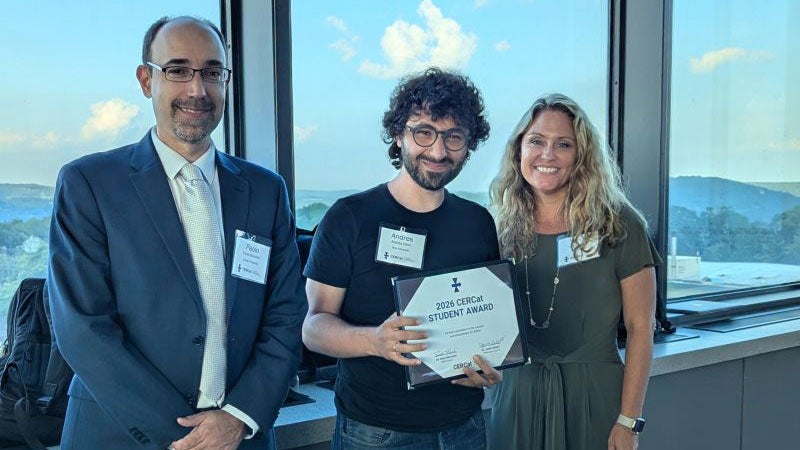
Andres Calvo, a Ph.D. candidate in Rice University’s Department of Civil and Environmental Engineering, received the best poster award at the Consortium for Enhancing Resilience and Catastrophe Modeling’s (CERCat) semi-annual industry advisory board meeting held Aug. 6–7 at Lehigh University in Bethleham, Pennsylvania.
Calvo was one of two award recipients chosen from 17 presentations for his poster, “Severe Convective Storm Multi-Hazard Hail and Wind Fragility Analysis of Low-Rise Structures.” His research, conducted under the mentorship of Jamie Padgett, the Stanley C. Moore Professor in Engineering and chair of the Department of Civil and Environmental Engineering at Rice, focuses on predicting how low-rise buildings withstand multiple hazards simultaneously.
“Andres has been doing great work in developing computational frameworks to accurately predict the structural reliability of low-rise buildings when threatened by multiple hazards,” Padgett said. “This poster award reflects how much our CERCat industry advisory board appreciates his contributions and their potential impacts.”
Calvo is developing a fragility assessment framework to assess the risk of damage to low-rise structures exposed to severe weather. The research aims to help industry catastrophe modelers, insurance companies and city managers better understand potential damage and losses to residential, commercial and industrial buildings during severe thunderstorms and hurricanes. The work could also help architects and engineers make informed decisions about building materials and roof designs in storm-prone regions, while providing city planners and policymakers with data to strengthen construction standards and reduce storm damage.
In collaboration with Guirong Yan and Jiahao Wang in the Department of Civil, Architectural and Environmental Engineering at Missouri University of Science and Technology, Calvo and Padgett plan to generate a toolkit of computational models to assess how standard roof and siding materials perform under high winds and hail.
They will run thousands of aerodynamic simulations using different storm intensities and building conditions to create risk models that measure how vulnerable various building components are when hit simultaneously by high winds and heavy hail. They will then validate and refine the models using damage data from past hailstorms.
“It is great to be part of a collaboration between industry and academia to improve our understanding of natural hazards and their impact on our built world,” Calvo said. “This award motivates me to keep pushing the boundaries of knowledge in this area.”