
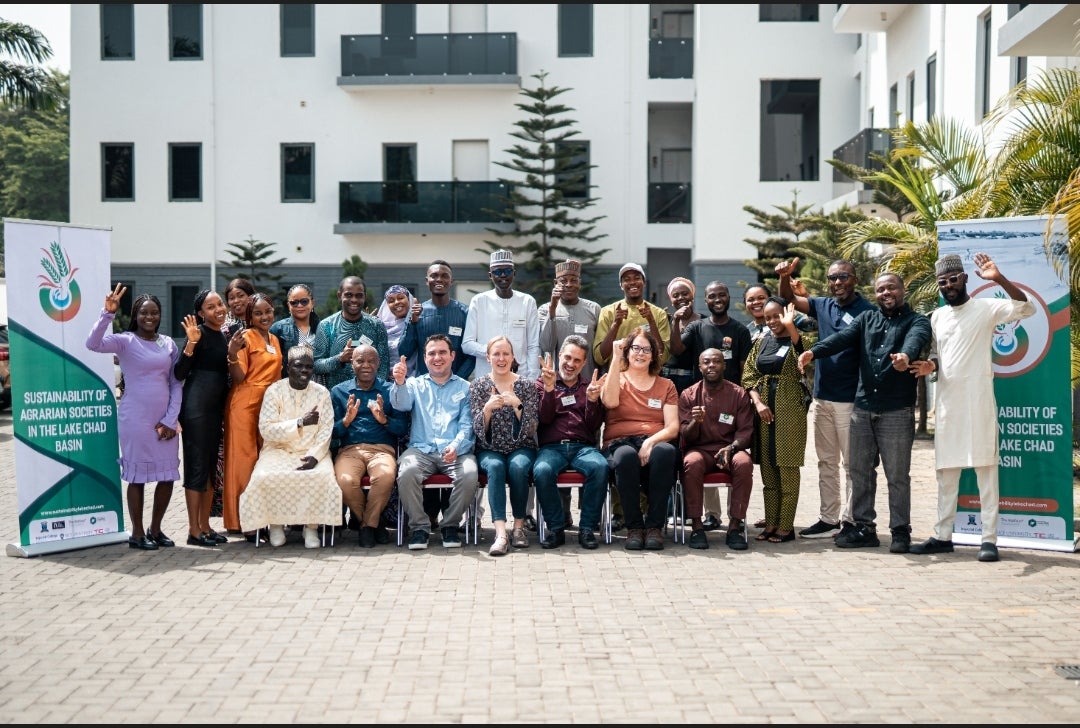
Photo credit: The photo first appeared in the Nigerian newspaper, This Day.
Frederi Viens, professor in the Department of Statistics at Rice University’s George R. Brown School of Engineering and Computing, led an international workshop in Abuja, Nigeria from Jan. 12-16, 2026, focused on applying advanced data science methods to urgent sustainability challenges. Titled, ‘Bayesian Statistics in Sustainability Science, with a Focus on Agrarian Societies and Ecosystem Services in the Lake Chad Basin’, the program equipped early-career scientists with practical tools to analyze complex environmental and socioeconomic systems and translate data into real-world impact.
Like many African nations, Nigeria has made significant strides in developing its academic and research capability and infrastructure challenges. However, Nigerian scientists still have limited access to advanced tools and datasets. Viens and a team of facilitators envisioned a workshop to fill this knowledge gap by training early-career scientists in Nigeria, Cameroon, and Zambia from diverse fields such as agriculture, soil science, geography, statistics, and sustainability science on advanced statistical approaches and tools, so they can successfully lead sustainability efforts in the Lake Chad Basin and other regions of Africa.
The instructional team consisted of Viens; two graduate students from the Department of Statistics at Rice, Quadri Popoola and Tripp Roberts; two research scientists from North Carolina State University, Katherine Muller (lead instructor) and Kathryn White; and Philip Ernst, professor at the University of Alabama. Other mentors included Okezie Chukwuemeka, lead meteorologist from the Nigerian Root Crops Research Institute in Umudike; Adam Lawan Ngala, a prominent soil scientist from the University of Maiduguri; and Udo Herbert, CEO of the Nigerian Institute for Animal Science.
This scientific capacity-building effort was part of the broader initiative that Viens has led for the past three years. That initiative, ‘Sustainability of Agrarian Societies in the Lake Chad Basin,’ is supported by the British Academy through The Wolfson Foundation. It uses rigorous evidence and data-driven studies to understand how climate change, population growth, and regional insecurity reshapes the livelihoods of farming, pastoral, and fishing communities around Nigeria’s Lake Chad region, as well as the nomadic herders whose livestock depend on its grazing lands.
Lake Chad had nearly disappeared during the severe Sahelian droughts of the 1970s and 1980s. For decades since, the popular narrative around the globe has been that Lake Chad was reducing in size and was often presented as an example of environmental collapse.
However, recent preliminary evidence from field surveys and long-term data collected and analyzed by Viens’s research team confirmed that Lake Chad is no longer shrinking. Their studies showed that the lake, which is known to have recovered from past droughts to a significant extent by 1995, is to this day successfully supporting the region’s farming, fishing and grazing activities. The team’s findings were corroborated by the lived experiences of 2,000 farmers from the region who Viens and his team interviewed. These studies and interviews have identified unpredictable rainfall patterns as a major source of agricultural uncertainty and crop loss in that region.
Notably, Viens and his team were among the first to combine advanced statistical analysis with farmers’ local knowledge to better understand the evolving ecology of Lake Chad and to ensure farmers have the information and practical tools they need to effectively predict, manage, and adapt to constantly changing conditions. Their rigorous data analysis and inclusive approach of engaging with local stakeholders have led to alternate viable solutions, such as using groundwater as a reliable source for irrigation, to address food insecurity in the region.
“We listen carefully. We speak Kanuri, the local language, we work through trusted enumerators, and we treat farmers with respect, which transformed the quality of the data we’ve been able to collect and helped us understand the complex interconnected factors affecting the crops, livestock and fisheries,” Viens said. “We leveraged that experience and our expertise to design this workshop to strengthen the participants’ ability to think probabilistically, analyze uncertainty, and apply Bayesian reasoning to real-world problems. I believe this workshop will equip researchers not just with statistical tools, but also with confidence to engage in high-impact, data-driven work, which when combined with the knowledge from local stakeholders, can produce transformative solutions to improve food security for the Lake Chad Basin and other regions in Africa.”
Viens’s philosophy resonated deeply with workshop participants like Favour Eke-Okoro, an agronomist at the workshop who said, “Bayesian statistics will help us predict crop production more accurately and mitigate challenges. This is essential for precision agriculture in Nigeria. It can spark a movement.”
Watch Viens discuss the workshop and its potential impact..
Read the news coverage by two leading Nigerian national newspapers, This Day Live and Leadership.