
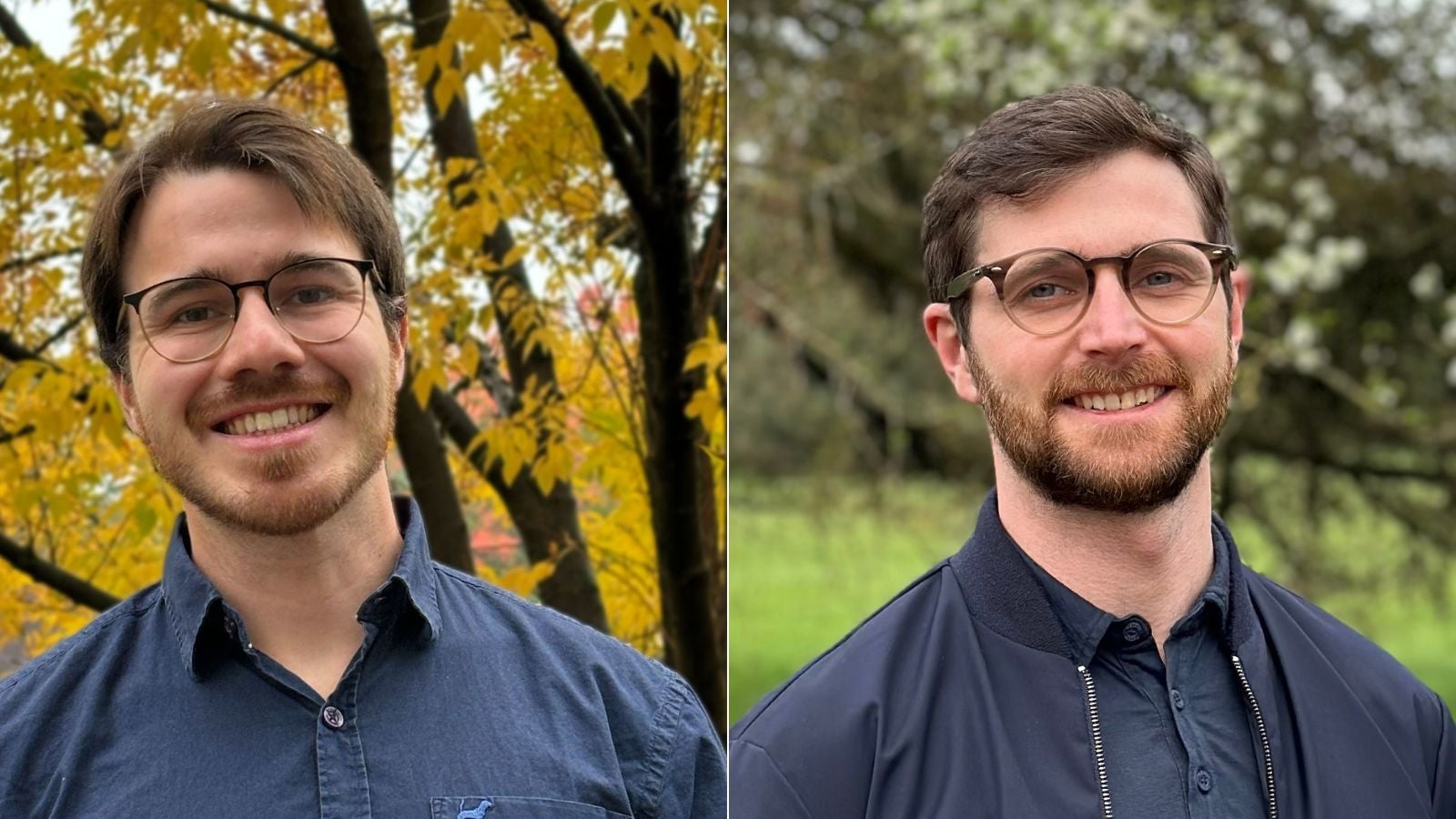
Assistant professors Guilherme Migliato Marega and Harris Pirie joined the Department of Materials Science and NanoEngineering in Rice University’s George R. Brown School of Engineering and Computing on Jan. 1, 2026.
Marega’s and Pirie’s respective backgrounds in nanomaterials and quantum materials help drive the department’s momentum as a global leader in the materials revolution.
At the helm of the Emerging Nanomaterials and Technology Laboratory (Emergelab), Marega explores emerging materials for applications in computing and electronic devices.
“One of my lab’s current research thrusts is utilizing two-dimensional materials—which are only a few atoms thick—to build memory and logic devices similar to those in our phones and computers, but with superior performance,” said Marega. “These devices are designed to perform more energy-efficient computation, offering a promising alternative for embedded artificial intelligence applications.”
“Professor Marega’s cutting-edge work will enrich our research community and expand opportunities for interdisciplinary collaboration,” said Karen Lozano, Trustee Professor and Chair of the Department of Materials Science and NanoEngineering.
Likewise, Rice University’s core value of interdisciplinary collaboration drew Marega to the Department of Material Science and NanoEngineering. “At Rice, I have the opportunity to collaborate with leading researchers across different materials platforms, fostering a synergistic approach to research,” said Marega.
Marega was most recently an experimental postdoctoral fellow in the Kavli Institute for Nanoscale Science at Cornell University. He holds a master’s from Ecole Centrale de Lyon, France, and a doctoral degree from the Swiss Federal Institute of Technology in Lausanne (EPFL), Switzerland.
Pirie brings a strong background in quantum materials to Rice University. His lab at Rice combines acoustic metamaterials, molecular beam epitaxy, and low-temperature scanning tunneling microscopy to prototype, fabricate, and characterize quantum materials. Research from the Pirie lab translates to real-world impact in future technologies, from ultra-efficient devices and sensors to quantum computers.
“Materials have underpinned every major technological leap in history, and quantum materials are poised to drive the next revolution,” said Pirie. “The goal of my lab is to accelerate the timeline from abstract idea to tangible quantum material.”
His lab is currently exploring how sound waves can enhance understanding of quantum mechanics. By using 3D printers to fabricate macroscopic 'twistronic' materials and measuring them with microphones, his team investigates complex quantum phenomena in simple tabletop experiments.
“Professor Pirie brings a powerful new perspective in quantum materials that will open new avenues for collaboration and will strengthen our department’s research and teaching mission,” said Lozano.
For Pirie, watching the growing momentum of Rice’s Department of Materials Science and NanoEngineering—among the fastest-expanding materials departments in the country—drew him to become a faculty member.
“It is exciting to join a department that isn’t just growing in size, but in vision—especially regarding the future of quantum materials,” said Pirie. “There is also a huge collaborative spirit here; it feels like a community moving in sync toward big breakthroughs. That ambition is matched by world-class capabilities: the Ralph S. O’Connor Building for Engineering and Science offers the state-of-the-art facilities required for the sensitive, atomic-scale measurements my lab conducts, making Rice the ideal home for this work.”
Pirie previously served as a Marie Skłodowska-Curie Fellow at the University of Oxford, U.K. He received his doctoral degree in physics from Harvard University.