
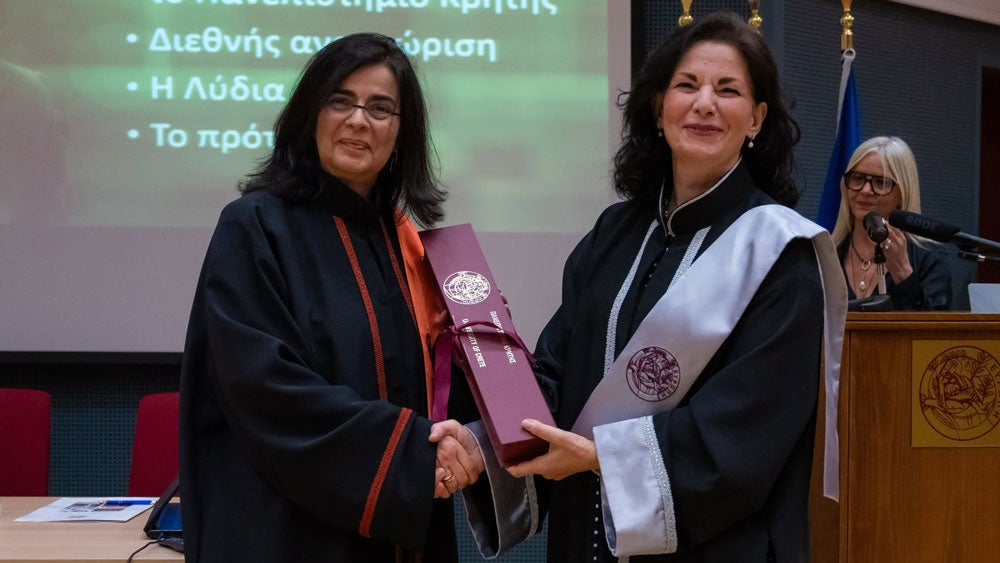
Credit: Department of Computer Science, University of Crete
Rice University’s Lydia Kavraki, University Professor, Kenneth and Audrey Kennedy Professor of Computing, and professor of computer science, electrical and computer engineering, mechanical engineering, and bioengineering and director of the Ken Kennedy Institute, was conferred an honorary doctorate of the Department of Computer Science of the School of Sciences and Engineering at the University of Crete, where she earned her undergraduate degree.
The University of Crete is one of Greece's leading research universities. According to the 2026 Times Higher Education World University Rankings, its Department of Computer Science, founded more than 40 years ago, is ranked first among all computer science departments in Greece.
Kavraki received this honor at a formal ceremony in Heraklion, Greece, where she delivered a keynote lecture titled, "The Computational Foundation of Modern Robotics” on July 20, 2026. This academic distinction recognizes Kavraki’s outstanding international scientific career, leadership and collaborations and honors her transformative research innovations in the fields of computer science, robotics, computational biology and artificial intelligence.
"Lydia’s foundational contributions to physical AI, robotics and computational biology have transformed how intelligent systems interact with the physical world to improve human lives," said Christopher Jermaine, chair of the Department of Computer Science at the George R. Brown School of Engineering and Computing at Rice University. "This honorary doctorate from her alma mater is a fitting recognition of her groundbreaking research, dedicated mentorship, and global scientific leadership. We couldn't be prouder to see her remarkable achievements recognized on the world stage."
A Pioneer of Physical AI and Ultra-Fast Robotics
A global leader in developing artificial intelligence models that operate within the constraints of the physical world, Kavraki bridges statistical reasoning, machine learning, and physics-based modeling to solve complex real-world challenges. Her research led to breakthroughs in safe human-robot collaboration, targeted drug discovery, and responsible AI.
She has developed foundational algorithms that enable robots to work seamlessly alongside and in support of humans across dynamic environments. Her lab has produced widely used open-source tools for robotics researchers and engineers around the world. Kavraki’s group achieved a landmark engineering feat in 2024, bringing planning times for complex robotic manipulations down to microseconds on conventional processors. Her motion-planning frameworks power real-world systems ranging from medical technologies such as stereotactic radiosurgery like the Gamma Knife to nurse training simulators and NASA astronaut support for space habitats such as Robonaut 2, a robotic assistant aboard the International Space Station.
Kavraki has applied these geometric and robotics-based principles to computational biology to model protein structures and molecular interactions, accelerating drug discovery and improving human health. In collaboration with Texas Medical Center researchers, her lab continues to use these molecular modeling techniques to design personalized cancer immunotherapies, vaccines, and therapeutics for viral infections and asthma. The web servers and computational frameworks her team has created are used extensively by the global biomedical research community.
As a strong advocate for responsible AI, Kavraki actively addresses ethical and societal risks of emerging AI technologies. Her research has evaluated sensor privacy risks with mobile robots operating in human environments and identified biases in AItraining data used to develop immunotherapies.
She has authored or co-authored more than 300 peer-reviewed journal articles and conference papers and is one of the authors of the widely used robotics textbook Principles of Robot Motion published by MIT Press. She has mentored more than 40 graduate students and postdoctoral fellows, who now hold faculty positions at leading universities and research roles in industry labs, startups, and major software companies.
Kavraki is an elected fellow of the Association of Computing Machinery (ACM), Institute of Electrical and Electronic Engineers (IEEE), American Association for the Advancement of Science (AAAS), Association for the Advancement of Artificial Intelligence (AAAI), and American Institute for Medical and Biological Engineering (AIMBE) and has received numerous awards for her pioneering research and scientific leadership. Notable among those are the Frances E. Allen Medal, Grace Murray Hopper Award, Athena Lecturer Award, Allen Newell Award, Robotics Pioneer Award, Anita Borg ABIE Technical Leadership Award, BioHouston’s Women in Science Award, and her recognitions as a top TR100 investigator by MIT Technology Review Magazine and Brilliant 10 Scientist from the Popular Science Magazine. She has also received many awards for research, teaching, and service from Rice University.
“Receiving this recognition from the University of Crete, where my scientific journey began, is profoundly meaningful to me,” Kavraki said. “The University gave me not only an excellent education that made my career possible, but also a way of thinking: the courage to ask difficult questions, the discipline to persist when problems appear unsolvable, and the conviction that science must ultimately serve people and society. Equally important, my education at the University of Crete in Greece immersed me in a humanistic tradition that places knowledge in the service of humanity and reminds us that scientific progress carries both purpose and responsibility. These values have remained a guiding force throughout my career, shaping my commitment to develop technologies that support human well-being—from robots designed to work for and alongside people to computational methods that contribute to the discovery of new therapeutics.”