
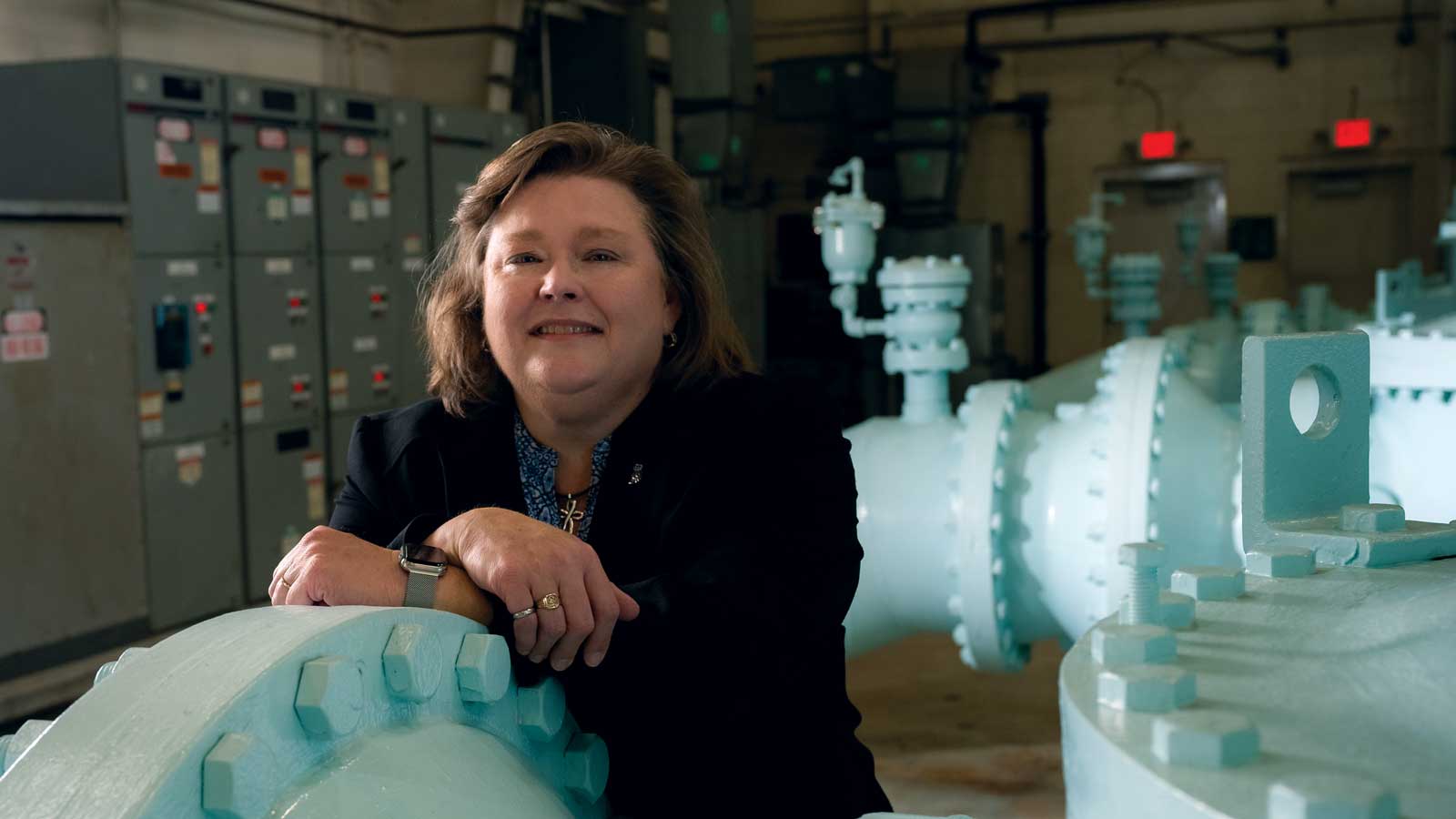
From her earliest days, water has flowed through Carol Ellinger Haddock’s life like a blessing and a curse.
“We heard people say, ‘The river is coming down.’ That was the expression they used. The river was running high. We would go out and watch it,” said Haddock, who grew up in the Hill Country of Texas.
Now, as a municipal director of public works, Haddock oversees major water, wastewater, street, and storm drainage systems. “Yes, a big part of this job is water. That means everything from clean drinking water to making sure the infrastructure is ready to deal with the next major storm,” said Haddock, who earned her bachelor’s degree from Rice University in civil engineering.
Haddock’s department manages a multi-billion dollar operating and capital budget, employing thousands of professionals within a highly accredited public works agency.
“We touch the lives of everyone in the city every day. The sense of responsibility is enormous,” said Haddock, who joined municipal public works as a senior assistant director for infrastructure planning before rising to department director.
Haddock thinks of herself as a small-town individual with a big-city job. During her early childhood, Haddock’s family lived in several small towns until they settled in the region. Like many budding engineers, she was building things and competing in math contests. Math always topped her list of interests.
“It’s what I was good at. My parents said they knew I would be an engineer,” said Haddock, who describes coming to the university as “a humbling experience.”
“Back home, I knew I was one of the smartest kids around,” she said. “At the university, I could be in the same room with dozens of other people and all of them were incredibly intelligent. I was out of my comfort zone for the first time.”
During her undergraduate years, Haddock participated in the student marching band, played French horn, and was active in the student chapter of the civil engineering professional society. Among faculty members, Haddock was especially close to a long-serving professor who taught at the university for almost half a century. Following graduation, she worked as a research associate for a prominent environmental engineering faculty member.
“Working in water felt like coming home,” said Haddock, who worked for several years as an assistant project manager for a regional consulting firm. She later joined a regional flood control district as a program manager for a multi-million dollar watershed infrastructure project. In her off-hours, Haddock earned a master’s degree in public administration.
She was subsequently selected to serve as a congressional science and engineering fellow, assigned to a federal environmental committee, which she notes was an exceptional career opportunity.
“Working in public policy really prepared me for the job I have today. I evaluated project and study requests, drafted policies, and set up tracking systems for major water resources legislation,” she said.
Returning to municipal public works, Haddock served as a senior assistant director for infrastructure planning. Promotions followed. She eventually served as deputy director for capital projects, overseeing hundreds of professionals in the design and construction of an expansive annual capital improvement plan, directing dozens of projects simultaneously through design and active construction phases.
Haddock was named interim director shortly before a catastrophic regional hurricane made landfall. After serving as acting director through the initial recovery phases, Haddock became the permanent director of public works.
“Historically, engineers were encouraged to avoid politics. Our ethics and scientific approach required us to stay clear of the gray areas. I no longer believe that’s the case. Engineers need to step up and be leaders. We need people with technical knowhow to contribute their expertise, especially in the political arena,” she said.
Haddock advocates for more resilient land-use and development controls across urban areas. Continued expansion and redevelopment make infrastructure management challenging, but she thrives on leading people, large-scale projects, and complex infrastructure budgets.
“There are days that are hard, but I also love my job,” she said.