
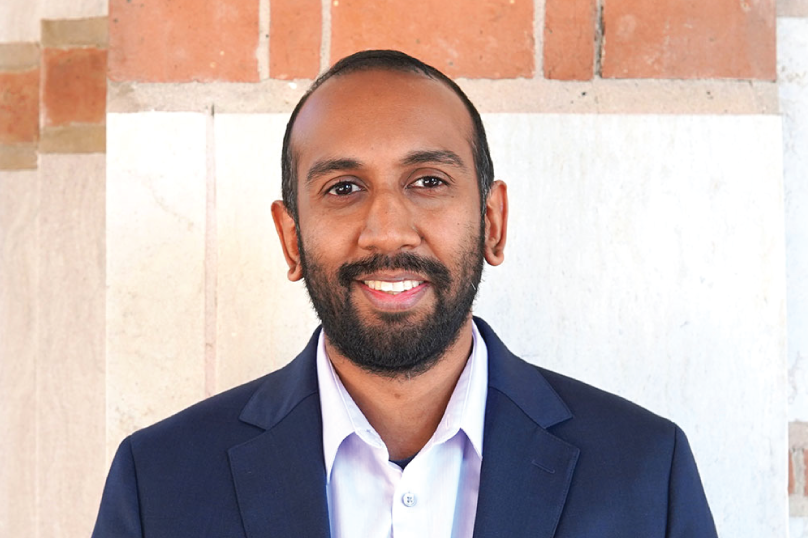
Guha Balakrishnan, assistant professor of electrical and computer engineering, at Rice University’s George R. Brown School of Engineering and Computing, has received the prestigious Faculty Early Career Development Program (CAREER) award from the National Science Foundation.
This five-year grant award will support his research in developing new artificial intelligence-driven approaches to analyze geospatial data such as satellite imagery and environmental sensors to tackle global challenges like climate change, agricultural planning, and energy transition.
"Guha’s work represents a fundamental shift in how we process massive, complex datasets," said Ashok Veeraraghavan, professor and chair of electrical and computer engineering at Rice. "By reimagining data representation, this research bridges the gap between advanced AI theory and critical, real-world solutions. The department is incredibly proud to see his innovation and academic leadership recognized with the NSF CAREER award."
Geospatial data are often enormous, incomplete and collected in many different formats, making them difficult for today’s physics-based and AI models— which typically analyze data as rigid, pixel-by-pixel grids—to interpret accurately.
To address this, Guha and team are proposing to build and train a new AI framework called the Multivariate Neural Field (MVNF). Instead of treating data as fixed grids of pixels, MVNF represents information as a continuous landscape, allowing AI models to better connect information from satellites, simulations and ground-based sensors. The datasets are analyzed using two steps:
- Shared "Encoder": Learns the overall, big-picture patterns shared across different types of data
- Specialist "Decoders": Translates those shared patterns into signal-specific details such as temperature, vegetation cover, or elevation.
By breaking massive datasets into manageable pieces, MVNF could dramatically reduce storage requirements while filling gaps in missing data and identifying similar geographic regions. The result would be faster, more complete analyses of Earth's changing environments. Guha plans to collaborate with Rice faculty, Jamie Padgett, Noemi Vergopolan, Jonathan Ajo-Franklin and others to demonstrate the usefulness of this framework across four diverse and challenging geospatial areas:
- Land surface temperature: To monitor climate change and urban heat islands
- Soil moisture estimation: To enable smart farming, irrigation, and accurate prediction of droughts
- Geophysical exploration: To locate natural resources and understand geological hazards
- Aerial debris estimation: To facilitate environmental cleanup and disaster response.
These cross-disciplinary collaborations build upon work supported by the Ken Kennedy Institute's research cluster initiative.
Beyond Geosciences:
Although designed for geospatial research, the tool will be available to scientists, urban planners, and environmentalists worldwide. The framework could benefit fields including signal compression, computer graphics, computational imaging, and 3D modeling where neural fields are already of major significance.
As part of the CAREER award's education mission, Balakrishnan will also develop an open-source Jupyter repository that students from high school through graduate school can use to explore data science and computer vision.
“Scientific datasets are becoming increasingly complex and large-scale, requiring us to build models with capabilities beyond the scope of traditional, rigid data models," said Balakrishnan. "We are thankful for this grant that will support our efforts in developing flexible AI representations for vital geospatial applications, democratizing the use of this technology for advanced capabilities among students and researchers globally.”