
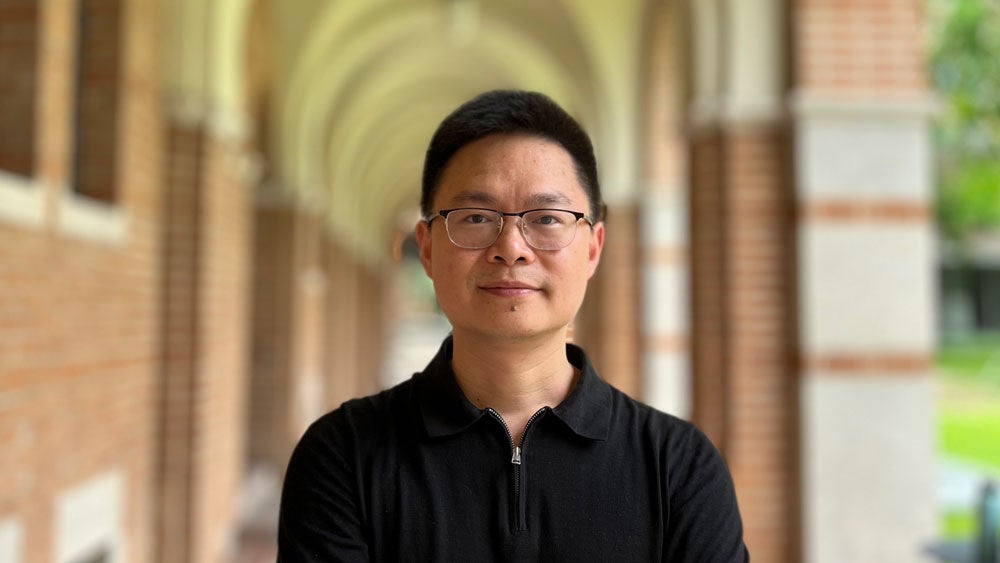
Kai Gong, assistant professor in the Department of Civil and Environmental Engineering, has received the Faculty Early Career Development Program (CAREER) award from the National Science Foundation. The five-year grant will support his research to develop an AI-powered modeling approach for designing customized concrete mixtures, helping engineers create more durable, affordable and sustainable infrastructure. By combining materials science research with artificial intelligence (AI), Gong aims to transform concrete design from a slow trial-and-error process into a predictive science, accelerating the construction of housing, transportation and energy systems while improving their long-term performance.
“Professor Gong has been on the forefront of AI-enabled design of infrastructure materials,” said Jamie Padgett, chair of the Department of Civil and Environmental Engineering at Rice. “I’m excited that this CAREER award will allow him to propel that work forward through physics-informed inverse design of cementitious materials to achieve the durability and cost-effectiveness required of future resilient infrastructures.”
Most modern construction relies on concrete. Over 30 gigatons are produced globally each year, making it the second-most consumed material on Earth after water. Yet, designing these mixtures remains a persistent challenge. Currently, formulation of concrete mixtures relies heavily on traditional recipes, prior experience, and repeated trial batches, making it slow, costly, inefficient, and inconsistent.
“Our goal is to modernize concrete design by integrating AI with materials science research and other data to design customized concrete blends that are optimized for a specific project,” said Gong. “As the construction industry moves towards using locally sourced and alternative materials like industrial byproducts in cement mixtures to reduce costs, and to meet performance and sustainability targets, the need for such AI-based predictive modeling tools becomes even more critical to ensure strong, affordable, and sustainable infrastructures.
While this project is focused on developing a foundational framework, Gong says this new approach can scale to a wide range of global infrastructure applications.
"Scalability is an important requirement for sustainable development," Gong said. "Whether optimizing concrete for an individual infrastructure project like a bridge or decarbonizing global cement production—which currently accounts for roughly 8% of global greenhouse gas emissions—this approach offers the precision needed to meet rigorous performance, durability, and sustainability targets.”