
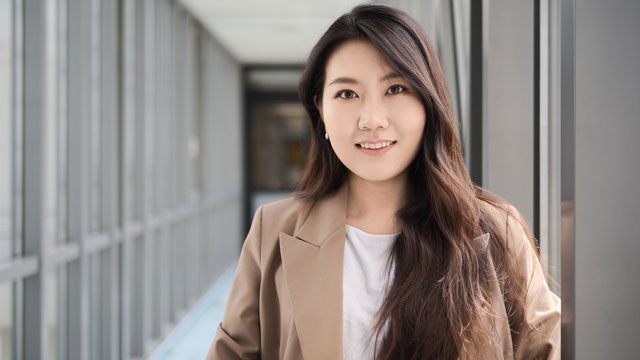
Yao Rong, a former postdoctoral associate in Rice University’s George R. Brown School of Engineering and Computing and a 2025-26 Future Faculty Fellow, has joined Leibniz University Hannover in Germany as an assistant professor of computer science. She will also be affiliated with the L3S Research Center, one of Northern Germany’s premier hubs for trustworthy AI and responsible digital transformation.
The Future Faculty Fellows program, which helps Rice postdoctoral researchers and doctoral students prepare for academic careers, played an important role in Rong’s transition to the faculty. Through the program, she worked with senior faculty on mock interviews and received guidance on her research, teaching and service statements, as well as her overall approach to the academic job search.
Rong’s research on human-AI collaboration, conducted under the supervision of her postdoctoral advisor, Vaibhav Unhelkar, assistant professor of computer science at Rice, has earned several major recognitions, including selection as an MIT EECS Rising Star in 2025.
Before coming to Rice, Rong earned a dual bachelor's degree from Tongji University and Munich University of Applied Sciences, followed by a master’s degree with distinction and a Ph.D. in computer science from the Technical University of Munich in 2024.
Preparing for the Faculty Job Market
Rong credits the Future Faculty Fellows program with helping her navigate the competitive academic job market and build relationships with senior faculty who provided guidance throughout the process. Mentors with significant faculty hiring experience conducted mock interviews and shared insights into how academic hiring committees evaluate candidates.
"Going through this process in a safe setting beforehand was very valuable,” Rong said. “It helped me anticipate the questions and mentally prepare the answers, making me more confident and relaxed during the actual interviews."
The program also paired Rong with teaching specialists at the Center for Teaching Excellence, communication advisors at Activate Engineering Communication, and campus leaders, who provided detailed feedback on her research, teaching, service statements and other application materials.
In addition to the Future Faculty Fellows program, Rong benefited from her experience as a Rice Academy Fellow, which gave her the autonomy to pursue her own research agenda while building skills in grant writing and interdisciplinary collaboration. She co-authored proposals to the National Science Foundation and Google Academic Research Awards alongside Rice faculty.
"As an Academy Fellow, I was able to interact with a wonderful cohort of colleagues across disciplines who were navigating the academic job market at the same time," she noted. "Having that moral support network of peers who were going through the same experience was just as valuable as the writing skills I picked up at the academy."
Advancing Trustworthy AI
In her new faculty role, Rong will continue studying how AI systems learn, reason and interact with people, with a focus on making them more trustworthy and reliable. Her research examines how complex AI systems process information and make decisions, as well as how AI agents can learn cause-and-effect relationships and apply that knowledge to unfamiliar problems without relying on step-by-step instructions or task-specific rewards.
Rather than simply correcting incorrect AI outputs, Rong wants to understand how AI systems develop conceptual knowledge and use it to guide their behavior. Her goal is to develop AI systems that are both capable and trustworthy enough for high-stakes applications.
In the near term, Rong plans to post-train large language models to improve their safety and capabilities while studying how they behave within the German AI ecosystem. Over the next two years, she plans to build her research team and establish international collaborations, including short-term summer visiting professorships abroad.
"Curiosity about how people from different cultures think and communicate applies directly to how I lead a team of international researchers and also influences how I design AI systems to accurately comprehend and respond to diverse perspectives and emotions," she explained.