
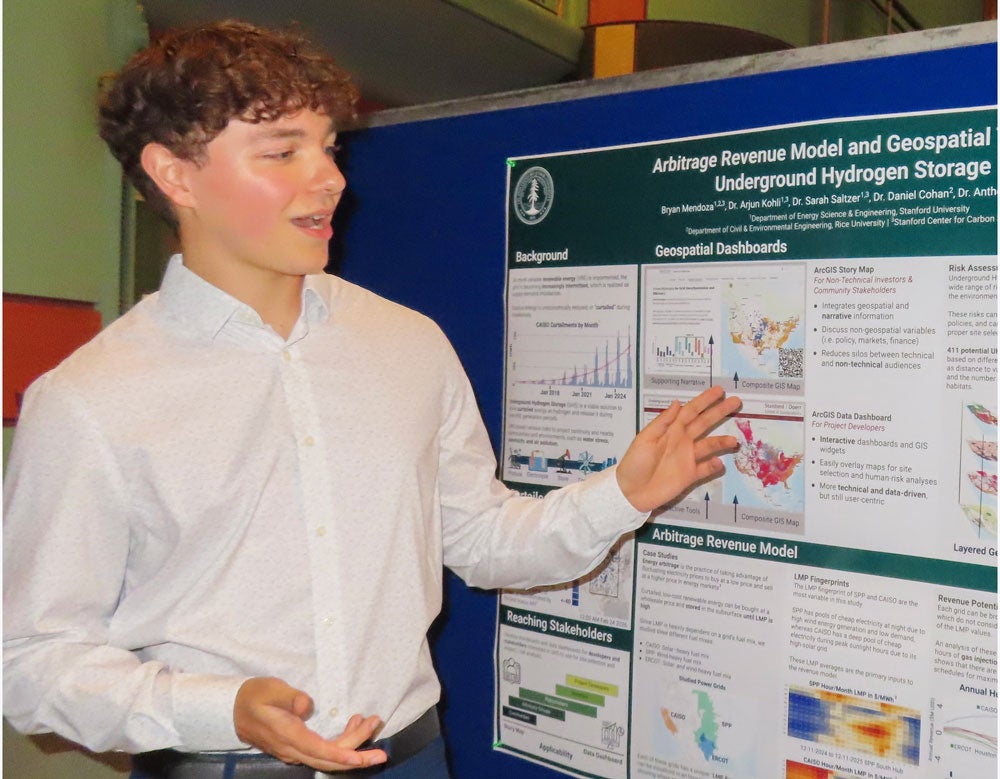
Bryan Mendoza recently made history as the inaugural graduate of Rice University’s new Bachelor of Science in Environmental Engineering (BSENVE) program, leveraging the environmental hazards he faced growing up as motivation to build a career in sustainable environmental engineering.
The BSENVE is a sustainability-focused engineering degree launched in 2024 that enables students to specialize in environmental engineering without taking courses in other civil engineering subdisciplines, such as structural engineering and mechanics. It is the only environmental-focused degree at Rice that provides a direct path to obtaining a Professional Engineering (PE) license.
Mendoza’s academic path at Rice University evolved slowly as he found his passion. He initially arrived as a physics major, building a foundation in analytical problem-solving before briefly exploring Earth, Environmental and Planetary Sciences. While he enjoyed climate research and diagnosing environmental problems, he felt drawn to engineering as a way to apply his skills to solving climate challenges.
The environmental hazards posed by the oil and gas industry had never been an abstract concept for Mendoza. Growing up in East Houston in a fence-line community near oil refineries and chemical facilities meant he saw and lived with their consequences.
“For my community, energy meant carcinogenic benzene in the air and shelter-in-place advisories due to naphtha fires. It meant hurricanes exacerbated by climate change inundating my neighborhood,” Mendoza said. “With time, I realized that the environmental injustices my community faced were not just failures of policy, but failures of engineering design and systems thinking. When Rice introduced a new major in Environmental Engineering, it provided me with an avenue to transform fear into agency.”
Rice professor Daniel Cohan's Energy and Environment course offered Mendoza his first hands-on experience with environmental engineering. “The course paired students with a Houston-based energy company to serve as their client for a challenge they brought forward. As a part of that challenge, four of us were challenged by Grid United to propose three electric transmission corridors across the U.S. that would reduce congestion, have feasible pathways for environmental and land permitting, and deliver cost-effective generation to meet demand.” The experience gave Mendoza an opportunity to collaborate with people from multiple disciplines to design energy solutions.
Beyond the classroom, Rice Wind Energy, a student-run competitive team and club, was one of the earliest drivers of Mendoza’s transition into the energy space. He served as its project development lead, growing the initiative from four contributors to 20 students across campus. Leading the team at the Department of Energy’s Collegiate Wind Competitions in Minneapolis, Boulder, and Vallejo for three consecutive years taught him how to develop wind energy designs that consider supply chains, meteorology, power markets, species at risk, community benefits, and other criteria.
Through those optimizations, he never lost sight of the most important lesson from his community: true engineering stewardship can sometimes mean sacrificing some megawatts of energy to protect local ecosystems and fence-line communities.
He took this same passion for environmental stewardship to an internship at EDP Renewables, where he built a database for renewable permitting in Canadian markets, analyzed grid price volatility across regional operators, and developed Python and AI tools to track legislative changes across North America.
“My summer at EDP Renewables was eye-opening. I interned with the Environmental team, and I didn't expect to collaborate with so many people across the company and even take lead on projects,” Mendoza said. “One of my projects with the Asset Management team was initially to identify risks of starting wildfires at EDP's solar and battery storage sites. As the project progressed, I was also able to research the effects of wildfire smoke on solar generation and electricity price volatility across PJM and ISO-NE, two regional grid operators.”
“We are very excited about our first student graduating from the new Environmental Engineering major and were not expecting to have our first graduate this early! Bryan did exceptionally well at Rice, earning three minors and serving as part of the Rice Wind Energy team that won second place at the DOE Collegiate Wind Competition,” said Jorge Loyo, director of the Energy and Water Sustainability (EWSU) Minor and assistant teaching professor in the Department of Civil and Environmental Engineering. “We are very proud of him.”
Mendoza’s EWSU capstone project built on his previous green hydrogen research conducted during a summer program with Stanford’s Department of Energy Science and Engineering.
Now returning to the Stanford Doerr School of Sustainability for a master’s in civil and environmental engineering with a focus on atmosphere and energy, Mendoza aims to build a career in global data, research, and energy intelligence with firms like Wood Mackenzie and S&P Global, or potentially return to EDP Renewables. “I'm drawn to the scale of the work done by these companies that is reminiscent of my research and academic career at Rice and Stanford,” Mendoza said.
As he prepares to leave Rice as the first graduate of the program, Bryan encourages incoming BSENVE students to approach challenges from various perspectives and with unconventional wisdom.
“The Environmental Engineering degree defines challenges in energy, water systems, and resiliency, and finding solutions to these daunting problems truly demands engineers understand and incorporate the concerns of grid operators, climate scientists, policymakers, community stakeholders, fence-line residents, and the environment itself in their engineering designs,” Mendoza said.