
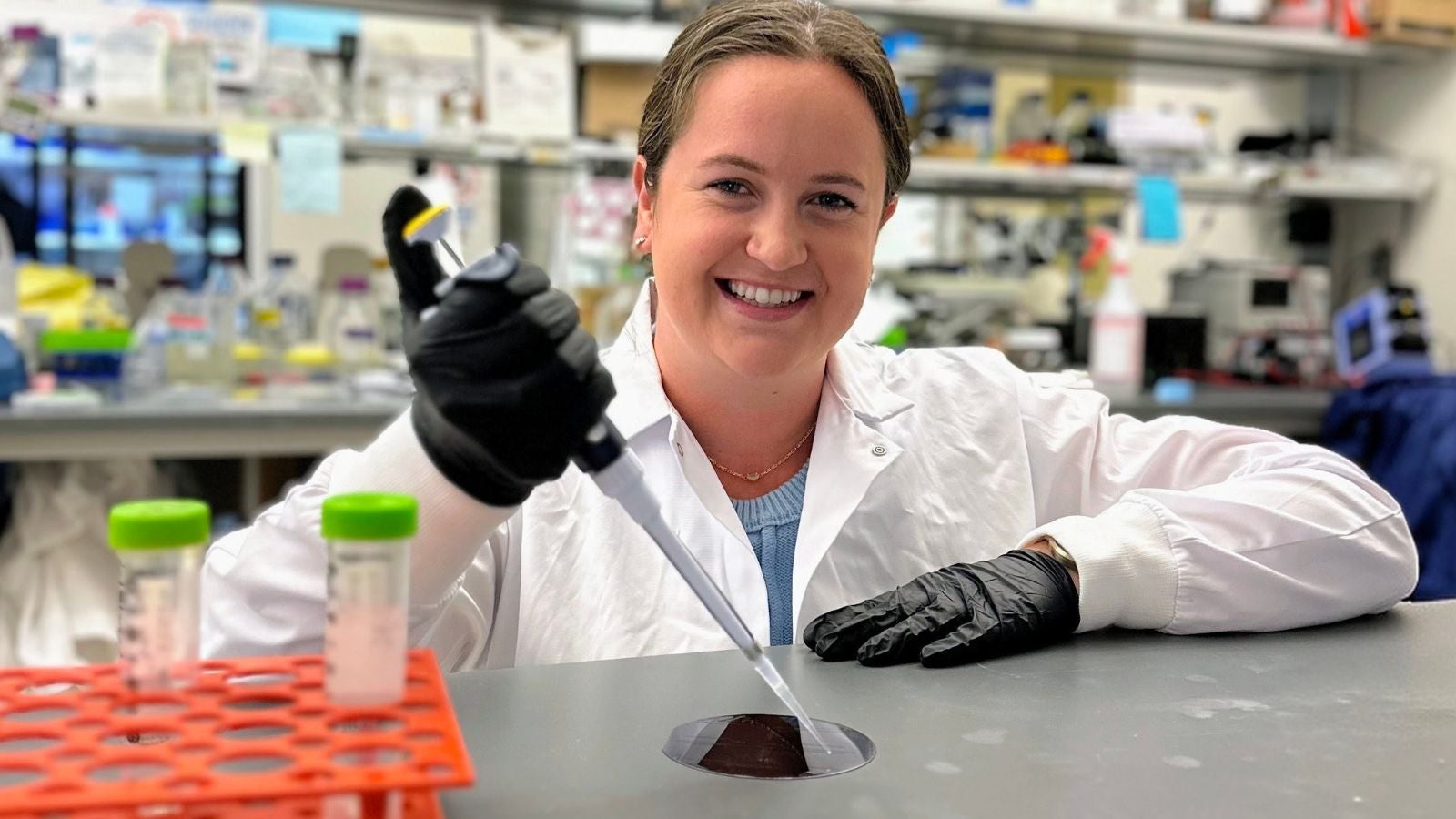
Pediatric cancers behave differently than adult cancers, and treatments for pediatric cancer patients are not just child-sized versions of adult therapies. A fellowship from the Damon Runyon Cancer Research Foundation and St. Jude Children’s Research Hospital aims to fill a critical gap in pediatric cancer research, and Rice University’s Abigail Clevenger is rising to the challenge.
Clevenger, a postdoctoral associate in the lab of Julea Vlassakis in the Department of Bioengineering at Rice University’s George R. Brown School of Engineering and Computing, has been awarded a 2026 Damon Runyon-St. Jude Pediatric Cancer Research Fellowship.
The fellowship provides funding to early career scientists focused on pediatric cancer research. Each fellow receives $300,000 over four years to conduct research projects that have the potential to significantly impact the diagnosis or treatment of pediatric cancers. Clevenger is one of five fellows in the 2026 cohort.
“Childhood cancers remain underexplored compared to adult cancers, and I believe they deserve dedicated investigation to improve outcomes,” said Clevenger. “Being named a Damon Runyon-St. Jude Pediatric Cancer Research Fellow is an incredible honor and a pivotal step toward my goal of becoming an academic scientist, where I can impact the biomedical research community and train future leaders in the field.”
Clevenger’s project focuses on Ewing sarcoma—an aggressive pediatric bone cancer with limited treatment options. In Ewing sarcoma, a key genetic fusion in tumors disrupts normal cell behavior and weakens the body’s immune system. Traditional cell cultures do not reflect the diversity of cells and immune interactions present in real tumors, making this cancer difficult to study in the lab.
For this fellowship, Clevenger will use advanced single-cell techniques to study how Ewing sarcoma cells build and reorganize their internal structures. By combining these novel approaches with analyses of patient tumor samples, her research will uncover how changes inside cancer cells help them evade the immune system and will point to new strategies for developing combination therapies for pediatric solid tumors.
Clevenger’s approach aligns with a trend in cancer research that prioritizes human-centered, in vitro models over animal testing—a shift accelerated by the FDA Modernization Act 2.0 and recent communications by the National Institutes of Health (NIH). According to the NIH, the emphasis on human-based research will accelerate medical advances and ethically improve human health.
“Abbie is highly qualified to lead the proposed research at the intersection of microscale assay design, tumor-immune interaction modeling, and single-cell and spatial omics of Ewing sarcoma, the second most common pediatric bone cancer,” said Vlassakis. “Given the FDA Modernization Act 2.0 and recent NIH announcements on the use of in vitro models, Abbie’s expertise positions her to be a leader in tumor microenvironment modeling, an approach being broadly embraced in academic and industry-based cancer research.”
Vlassakis and Michael King, E.D. Butcher Professor of Bioengineering, both serve as sponsors for Clevenger’s project for this fellowship.
“I am deeply grateful for the guidance I’ve received at Rice from my mentor, Dr. Julea Vlassakis, whose expertise has been instrumental in shaping my scientific perspective,” said Clevenger. “I have also benefited from the collaborative research environment at Rice with additional support from Dr. Michael King.”
Clevenger’s work in this project builds on her doctoral research, for which she developed a peristaltic bioreactor to mimic the tumor-immune microenvironment in colorectal cancer. Clevenger received her PhD from Texas A&M University and her BS from Trinity University.